Taiwan Lit and the Global Sinosphere

Becoming Settler-Colonial: Seqalu–Formosa 1867, Puppet Flower, and Indigeneity in the Narration of Taiwanese Nationalism
1 For discussions and suggestions that were essential to the development of this project, I would like to thank all the organizers and participants of the following: the “Texas Asia Conference: Transitions & Transformations,” at the University of Texas at Austin on January 25–26, 2022; the “Transnational Turns and the Future of China Studies” workshop at the University of California – Santa Cruz, on May 12–13, 2023; the “Remembering Taiwan and Vietnam” panel at the annual conference of the Society for Cinema and Media Studies, Denver, April 15, 2023; the “Mediated Passions: Affective Technologies in China and Taiwan” panel at the annual meeting of the Association for Asian Studies, Boston, March 17, 2023; and invited talks hosted by Media and Cultural Studies at Macalester College on February 22, 2024, and the Center for East Asian Studies at the University of Chicago on October 24, 2025, co-sponsored by the Department of Cinema and Media Studies and the University of Chicago Library.
In the first episode of the 12-part Taiwan television series Seqalu: Formosa 1867 (斯卡羅; dir. Jui Yuan Tsao 曹瑞原), the wise nineteenth century aboriginal chief Tokitok (Zhuoqidu 卓杞篤) argues with another chief who is militantly hostile to Chinese settlers on the island: “The soil never rejects a seed; without the Han Chinese, we have no salt, steel, or guns.” The metaphor is striking; the Han settlers, planted in the welcoming soil of Taiwan, will presumably take root and become as much a part of the environment as the indigenous peoples. Earlier in the episode, Tokitok employs another metaphor from Taiwan’s forest ecosystem to describe the relations between Chinese settlers and indigenous peoples, explaining that “trees and vines need each other.” The suggested ideal of ethnic harmony and a shared, natural belonging to the soil of Taiwan provides a clue to the ideological function of the series as a whole: to narrate history in such a way that Taiwan is projected as inclusively multiethnic but exclusive of China. It does so by mapping transnational political and military entanglements that include the Qing Dynasty, Han Chinese settlers, the United States, and multiple indigenous nations of Taiwan in the late nineteenth century, not long before Taiwan was formally named a province of China and then, ten years later, ceded to Japan after the First Sino-Japanese War.
Seqalu first aired on Taiwan’s Public Television Service (PTS) from mid-August to mid-September 2021, “breaking PTS’ all-time debut rating record for a drama” (Huang 2021). It continues to be available streaming on Netflix in Taiwan and on the government-sponsored Taiwan Plus streaming service throughout the world outside China. In what follows, I will explore how the TV series, and secondarily its source novel from 2016, amounts to a complex expression of contemporary Taiwanese nationalism—which is to say, the assertion of Taiwan as a sovereign nation separate from China—that incorporates the relatively recent notion of “fractional aboriginality.” This refers to the phenomenon of drawing upon genetic studies of contemporary Taiwanese to conceptualize a generalized “Taiwanese genome” that “contains an Aboriginal contribution”—a small but substantial percentage of indigenous DNA even in most Taiwanese of the Han ethnicity—in order to “support claims to a unique Taiwanese identity, an identity that specifically seeks to disarticulate itself from a Chinese one” (Liu 2012, 330). As Mark Munsterhjelm summarizes in his book about genetic research on Taiwan aborigines:
Taiwanese nationalists have used Taiwan Aborigines’ genetics as signifiers of a distinct Taiwanese identity. This use of Taiwan Aborigines’ genetics and the underlying symbolism of shared blood is supposed to strengthen Taiwanese sovereignty claims against Chinese nationalist claims that Taiwan is an inalienable part of China. Such usage is typified in the Taiwanese nationalist expression: “We have Chinese fathers but not Chinese mothers” (Munsterhjelm 2014, 7–8).1 A translation of 有唐山公,無唐山媽. Tn̂g-soan [唐山, <i>Tangshan</i> in Mandarin] was traditionally used by the settler community in Taiwan to refer not to the city in north China but to the area of south China from whence the Hoklo and Hakka settlers migrated, with Tang referring to the Tang Dynasty (Chiung 2018, 43) and <i>Tangshan</i> referring to China as homeland.
In the process of bolstering this claim through a sentimental personal narrative woven into a partially factual historical drama, Seqalu simultaneously centers Taiwan’s indigenous peoples in its narration of Taiwan history while also serving as an example of how contemporary Taiwanese nationalism co-opts and instrumentalizes indigeneity for its own purposes. I will focus in particular on how Seqalu mediates contradictions relating to indigeneity and settler colonialism that come to the fore precisely when Taiwan asserts its sovereignty apart from “China” (an entity imagined to be continuous through multiple political regimes) because—as I will explain below—that is precisely when Taiwan’s society is forced to reckon with its “settler-colonial unconscious” (Hirano et al. 2021).
Are Taiwan’s Indigenous People Chinese?
For thousands of years before it was dubbed Ilha Formosa, or “beautiful island,” by Portuguese sailors in the sixteenth century, Taiwan was populated by over a dozen broad groupings of Austronesian peoples with varied languages and customs. It was the Dutch, in trying to colonize the island in the seventeenth century, who initiated the large-scale migration of Han Chinese—the ethnicity that makes up more than 90 percent of China’s population—from southern China to Taiwan for mainly agricultural labor.1 Before the seventeenth century, the only known presence of Chinese people on Taiwan were occasional pirates and, in the sixteenth century, a small number of fishers and merchants from China’s coastal Fujian province (Ye 2019, 16). These Han settlers consisted largely of so-called Hoklo people (福佬人) from Fujian province—speakers of the Hokkien or Minnan (閩南) language, now simply called Taiwanese (台語) in Taiwan—and Hakka people (客家人) from Guangzhou province. The island became a Chinese territory only after it served briefly as a Ming loyalist base after the fall of the Ming Dynasty, making it a threat for the Qing Dynasty to subdue. However, it is important to note that from Taiwan’s annexation by the Qing in 1683 up until its ceding to Japan as a colony more than two hundred years later, the Qing empire never actually exercised sovereignty throughout the island; most of the mountainous regions in the eastern two-thirds of the island were still populated by indigenous tribes, which traded with the Chinese in the western part of the island but for the most part were never forced to accede to Qing rule in their own territory. During this same period, however, the Hoklo and Hakka Han settlers of the western lowlands (which were better suited for agriculture) became a majority of the island’s overall population. After Japan’s defeat in World War II and Taiwan’s subsequent territorial retrocession to what had, with the fall of the Qing Dynasty, become the Republic of China, the Republican government itself soon fell to the Communist revolution and fled to Taiwan as practically its only remaining territory. As a result, Taiwan’s existing Hoklo and Hakka settler population (benshengren 本省人, or “people from this province”) were forcibly joined by the fleeing Nationalist or Kuomintang (KMT; Guomindang in today’s pinyin spelling) government along with what was left of its army and various refugees (together constituting the so-called waishengren 外省人, or “people from other provinces”). The breakdown of the population of Taiwan today is approximately 70 percent Hoklo Han and 15 percent Hakka Han who descended from earlier Chinese settlers, and 10 percent waishengren or “Mainlanders” of mostly Han ethnicity who arrived after 1945 and dominated Taiwan’s political and economic life through the Cold War period until their hegemony began to wane following democratization in the 1980s–90s. The indigenous peoples who populated the entire island before the seventeenth century now constitute around 2.3 percent of the population (“Demographics of Taiwan”).1 For the percentage of the population that is indigenous, I have seen estimates ranging from 1.7% (Chiung 2018, 39) to 2.6% (“Ethnic Groups,” Executive Yuan). Of course, the number goes higher if one includes the “plains aborigines” (see note 16 below) who had mostly assimilated into the Han population by the late nineteenth to early twentieth century but more recently have reclaimed indigenous heritage, and it goes all the way to 85 percent of the population if one accepts the claims of Dr. Lin Marie (Lin Mali) (Cheng 2023, 947–948) discussed later in this article and includes anyone in Taiwan with even fractional indigenous ancestry. Here the breakdown of the population into Hoklo, Hakka, Mainlander, and Indigenous corresponds to the concept of “Taiwan’s four great ethnic groups” proposed beginning in 1989 by the newly legalized opposition Democratic Progressive Party (DPP) in an effort to expand its nationalist appeal beyond the Hoklo “Taiwanese” (Minnan)-speaking population to the Hakka, the aboriginal peoples, and what they anticipated to be more and more Taiwanese-identifying Mainlanders. The notion was soon taken up as well by the ruling KMT as it adopted a more Taiwan-centric focus under President Lee Teng-hui (Rudolph 2004, 98–99, 105).
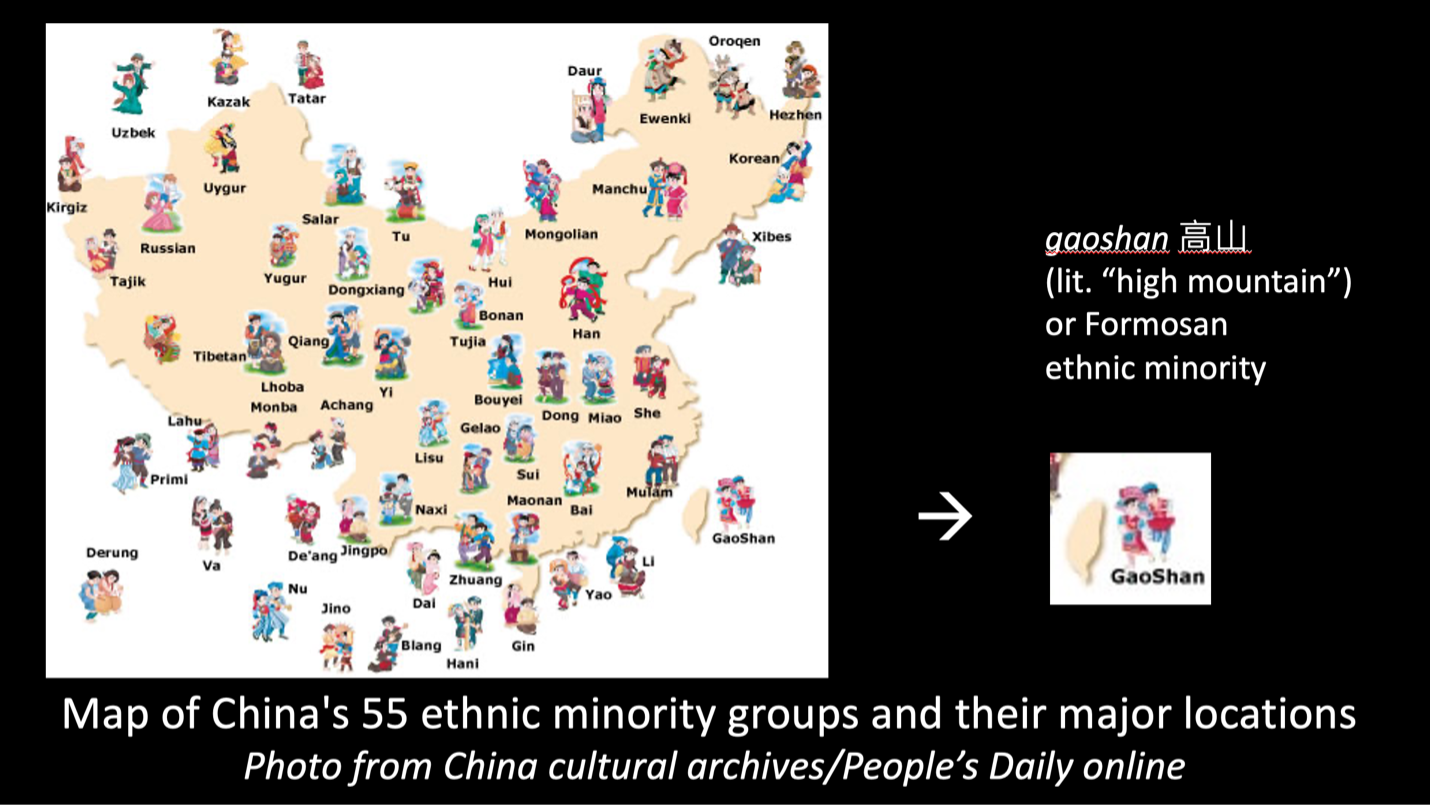
That is comparable to the percent of the population who are Native, First Nations, or Aboriginal in the US (2.9%), Canada (5%), and Australia (3.8%), respectively. All those are quintessential settler-colonial societies, in which the descendants of settlers far outnumber the descendants of indigenous people. Does that make Taiwan a settler-colonial society? From the perspective of the People’s Republic of China (PRC), which still claims Taiwan as a Chinese province—or, for that matter, the KMT-led Pan-Blue political coalition in Taiwan, which opposes independence from China—the answer is definitely “no.” Instead, as Lin-chin Tsai puts it, indigenous peoples are “minoritized”—considered as ethnic minorities rather than indigenous populations (Tsai 2019, 13). The PRC officially recognizes fifty-five ethnic minority groups in China, which, together with the Han majority, constitute the “Chinese ethnicity/nation” (中華民族). A PRC map of China’s ethnic minorities labels one of them the so-called “high mountain people” (高山族) of Taiwan, sometimes called the “Formosan” ethnic minority in English materials (Figure 1). It is worth noting that this constitutes a dramatic lumping together of many different Taiwan indigenous peoples with a diversity of languages and cultures, but in any case, in the PRC view that groups all the indigenous peoples of Taiwan into one Chinese ethnic minority among fifty-five, the growth of the Han Chinese population to become the vast majority of the population in Taiwan was merely a matter of internal migration within China’s sovereign territory, not a colonization. As Katsuya Hirano, Lorenzo Veracini, and Toulouse-Antonin Roy point out, under KMT rule in Taiwan as well, “the indigeneity of Aborigines” “was officially denied throughout the Cold War”: “Like minorities in China, [they] were declared to be Chinese” (Hirano et al. 2021, 242) and “relegated to the derogatory category of ‘mountain compatriots’ (山胞 shanbao)” (Tsai 2019, 10).
In fact, pro-unification historians on both sides of the Taiwan Strait in recent years have collaborated to argue that the appearance of indigenous people in Taiwan was itself only a result of internal migration since, these scholars claim, they most likely originated from a yue ethnic group (越族) in the coastal area of (now) southeast China just six thousand years ago. (This argument glosses over the fact that the coastal area in question was not part of anything like a Chinese civilization at the speculated time of migration, and even the earliest Chinese dynasties took shape thousands of years later and a thousand kilometers to the north.) Therefore, these scholars explicitly argue, it is wrong to even call Taiwan’s “high mountain” ethnic peoples “indigenous” or “originally inhabiting peoples” (yuanzhumin 原住民, itself a relatively new term that did not gain traction until the 1980s); instead, they should be referred to as xianzhumin 先住民, or the “first inhabiting peoples,” meaning essentially the first settlers from the mainland, preceding their later Han compatriots (Cheng 2023, 963).1 For more on the “southern origin theory,” see Stainton (1999), 28–32. Organizations representing Taiwan’s indigenous people, on the other hand, embrace the “indigenous” label. As the “Joint Declaration by the Representatives of the Indigenous Peoples of Taiwan serving on the Indigenous Historical Justice and Transitional Justice Committee” put it in 2019, “We are the Indigenous peoples of Taiwan, and we’ve lived in Taiwan, our motherland, for more than 6,000 years. We are not the so-called ‘ethnic minorities’ within the Chinese nation. ... Taiwan is the sacred land generations of our ancestors lived in and protected with their lives. It doesn’t belong to China. ... Once called ‘barbarians’, we are now recognised as the original owners of Taiwan. We the Indigenous peoples of Taiwan have pushed this nation forward towards respect for human rights, democracy, and freedom. After thousands of years, we are still here. We have never given up our rightful claim to the sovereignty of Taiwan.” (quoted in Alsford (2021), 25) In short, narratives of Taiwan as an essential part of China, whether circulating in mainland China or in Taiwan itself, labor to be at odds with any concept of Taiwan as a settler-colonial society; it is only to the extent that Taiwan is conceived as not just another territory or province of China but its own nation-state that it must also be acknowledged as fulfilling the theoretical definition of a settler-colonial society, as will be elaborated below.
Applying Theories of Settler Colonialism to Taiwan
Before turning to my analysis of the Seqalu TV show and its source novel, I will establish the grounding of my argument in theories of settler colonialism and its paradoxes, with a particular view to how the analytical approach of settler colonialism differs from more general theories of colonialism and postcolonialism. This is especially important since the latter analytical approaches can serve to obscure the former and potentially write indigenous peoples out of history. That is, if coloniality in Taiwan is limited to consideration of how the island experienced various degrees of successive colonization by the Dutch in 1624–1662, the Japanese in 1895–1945, or even the Americans by way of a protectorate client state under KMT martial law in 1949–1987, then Taiwan today can be considered “postcolonial.” However, as Shu-mei Shih puts it, “postcoloniality, the specific condition after colonialism that nonetheless retains residual effects of coloniality, does not apply to indigenous peoples who continue to live under settler colonization” (Shih 2021, ix). To counter such obfuscations, Shih insists that the “a priori fact” that “Taiwan is a settler colony where indigenous Austronesian peoples have been colonized for several hundred years and yet endured” should precede “all ways of understanding Taiwan’s history.” She sees the “necessity to center indigeneity in conjunction with the imperative of settler colonial critique” as essential for the “decolonization of Taiwan studies” since “settler colonialism is ongoing for indigenous peoples.” In this context, the claim to “fractional aboriginality” that, as I will detail below, underpins particularly the fictional aspects of Seqalu’s narrative, must be critiqued as part of a “settlers’ ‘move to innocence’ that displaces their own statuses as colonizers” (Shih 2021, x). If virtually all Taiwanese become “indigenous,” the actual historically aboriginal people are thereby at least partially disappeared by such a national narration that claims indigeneity for all.
Lorenzo Veracini’s 2010 book Settler Colonialism: A Theoretical Overview gives a restrictive definition of settler colonialism in the process of distinguishing it from colonialism in general. Veracini begins with Georges Balandier’s seminal definition of “the colonial situation” as “the domination imposed by a foreign minority, racially (or ethnically) and culturally different, acting in the name of a racial (or ethnic) and cultural superiority dogmatically affirmed, and imposing itself on an indigenous population constituting a numerical majority but inferior to the dominant group from a material point of view” (Veracini 2010, 4)—a description that well describes, for example, the Indian subcontinent under British rule, Indonesia under Dutch rule, and the Philippines under Spanish and then American rule. It also describes Taiwan as a Japanese colony from 1895 to 1945, or perhaps even Taiwan as subject to domination by the newly arrived KMT regime as a client state of the US empire for many decades after the departure of the Japanese—the two ways in which Taiwan has most often been analyzed as postcolonial, as mentioned above.
However, Veracini points out that Balandier’s definition of “the colonial situation” is entirely inadequate for coming to terms with settler colonialism. After all, strictly following a definition of colonialism as a minority from elsewhere dominating an indigenous majority, as soon as the outside settlers reach majority status in a territory, they no longer fit the definition of colonizers, and as soon as the indigenous population becomes a minority, they are no longer colonized, which is obviously nonsensical. Instead, in Veracini’s framing, what is distinctive about settler-colonial states is that the colonizers not only become the majority, but they lay claim to their own sovereign polity in the territory they have settled. Thus, the classic settler colonies of British imperialism—the United States, Canada, Australia, and New Zealand—all not only became majority white but also eventually claimed autonomy from Great Britain.
Veracini’s definition of settler colonialism is therefore narrower than just any situation of colonialism that involves settlers, in ways that are crucial to approaching the history of Taiwan from the Qing Dynasty to the present and to understanding contemporary Taiwanese nationalism. Compared to the Ming Dynasty, the Qing roughly doubled the size of the territory known as “China”—meaning “the Middle Kingdom” (Zhongguo 中國) populated by the hua 華 people as defined in contrast with the “barbarians of the four directions” (siyi 四夷). The course of Qing expansion was accompanied by the effort to assimilate the latter into the former as a multiethnic empire. In expanding its territory to Taiwan’s lowlands to counter its brief period as a Ming loyalist base, the Qing changed the island’s previous status, up through the Ming Dynasty, as either terra incognita or at best “a ball of mud beyond the seas” (Teng 2006, 2) into a land of growing Chinese settlement and part of the Qing empire.1 Teng notes the irony that “the ‘territorial integrity’ that [today’s] Chinese nationalists seek to defend is based on a territorial image of ‘China’ created by an invading Manchu dynasty, and not the older Ming image” (Teng 2006, 6).
As a newly, if only partially, acquired territory, Taiwan shared the situation of other newly conquered Qing territories such as Manchuria, Mongolia, Xinjiang, and Tibet. This raises the question of whether Xinjiang and Tibet today could also be characterized as settler-colonial, insofar as they have seen significant Han migration. Shu-mei Shih, for example, in the same essay cited above, at one point cites “China’s deepening settler colonization” of Tibet, referring to Han Chinese settlement of the territory (Shih 2021, xi). Lin-chin Tsai, Shih’s former student and now a professor at Taiwan’s National Cheng Kung University specializing in settler colonialism in Taiwan, never mentions Tibet or Xinjiang in his PhD thesis on settler colonialism and Taiwan culture. His initial definition of the term—“a specific colonial formation whereby settlers displace the indigenous residents and take over the land” (Tsai 2019, iii)—would seem to potentially include those territories, but he later clarifies as follows: “Once the number of immigrants in a society exceeds the indigenous population, … [i]t is then that the society can be defined as a settler colony” (Tsai 2019, 16)—a condition that is not yet true of Xinjiang and probably never will be in the case of Tibet, where Han remain a tiny minority of the population. Tsai cites Veracini throughout his study, and he seems to roughly follow the latter’s even stricter definition that settler colonialism involves settlers making a claim to political sovereignty: “In order to rationalize their permanent residency and transform new territories into their homeland, settlers develop an efficient and strong settler narrative to claim their own legitimacy and localness that is often selective and fictionalized” (Tsai 2019, 17). Veracini explicitly insists that “settler colonialism should be seen as structurally distinct” from other forms of colonialism, even those involving settlers, due precisely to the “sovereign entitlement” claims of settlers after they not only become a majority of the population but also seek sovereignty for the territory they have settled. Other scholars in Taiwan studies share this strict definition of settler colonialism that distinguishes the situation of Taiwan (or the United States, Canada, Australia, etc.)1 For a summary comparison of Taiwan’s settler colonialism with that of the United States, Aotearoa New Zealand, Australia, and Israel, see Tsai (2019), 22–29. from that of Xinjiang or Tibet. For example, indigenous scholar Kuan Da-wei (Daya Dakasi), an ethnography professor at National Chengchi University (NCCU), plainly states that “settler colonialism is a process whereby indigenous populations are replaced with exogenous settler groups that in turn develop a sovereign, state-seeking identity” (Kuan 2021, 184; emphasis added). By that stricter definition, “the settler-colonial situation” does not apply to Tibet and Xinjiang, the situations of which Veracini chooses to describe as “colonialism with settlers” but not “settler colonialism” (Veracini 2010, 4). At best it might fit what Lin-chin Tsai discusses as “internal colonialism” (though he rejects that label in favor of his settler-colonial critique in the case of Taiwan). Whether one chooses to apply the term settler colonialism more broadly or more narrowly, the profound differences the stricter definition draws out between the situations must be acknowledged. It’s not just that Tibet and Xinjiang would only fit the stricter definition of settler colonies if Han Chinese became the majority of the population—which has not (yet) happened in either territory—and that those territories would have to seek autonomy from China; even beyond that, Kuan’s and Veracini’s stricter definition would only apply if it were a new Han settler majority that sought independence rather than the indigenous population. It is precisely the assertion of autonomy by the settlers from their own ancestral homeland that defines the settler-colonial situation in the specific sense of the term as employed by Kuan and Veracini. The point is that a colonial situation undergoes fundamental transformations when the settlers outnumber the natives, and even more so when it is those very settlers who pursue autonomy from the colonizing metropole. The independence movement in Taiwan fits the more restricted definition of settler colonialism since the vast majority of both its leaders and supporters have been from the Han settler populations (whether Hoklo or Hakka), not the indigenous peoples (who, on the contrary, tend to align politically with the anti-independence Pan-Blue coalition, as will be discussed later).
Whether using a broader or stricter definition of settler colonialism, no doubt many disagree with Shih’s insistence on viewing Taiwan through the lens of settler-colonial critique. Is it fair to apply to Taiwan a term so closely tied to white European colonization? Do we not collapse Asian difference through such a universalization of a theoretical term arguably rooted in the Western experience? For example, it could be argued that the vast majority of the Han settlers of Taiwan were not privileged colonizers but poor, ordinary people from southern China who migrated merely to seek opportunities for livelihood. They also had enough diversity—especially the distinction between Hakka and Hoklo—that different Chinese subgroups had different patterns of settlement and often engaged in ethnic conflict even amongst themselves.1 Thus Melissa Brown concludes that in the island’s early Han settlement there was “no evidence of unity among the Han,” but rather “feuding (<i>xiedou</i>) based on ethnicity, lineage, and place of origin erupted frequently in Taiwan, with alliances crossing and recrossing these identities as circumstances varied ..., thus showing no signs of [Han] ethnic solidarity” (Brown 2004, 7–8). There was so much interbreeding with the local indigenous peoples—the “plains aborigines” (pingpu yuanzhuminzu 平埔原住民族; formerly pejoratively referred to as “cooked savages” shufan 熟番) in particular—in the settler areas that the settlers sometimes did indeed have indigenous ancestry and vice versa, and multiple plains tribes were assimilated and acculturated to the point of virtual disappearance. And yet, all of those points—the modest means of many settlers and their linguistic and cultural diversity (sometimes even mutual hostility) as well as the fact of intermarriage with natives—could equally be said of, say, the American frontier during its westward expansion. Another objection might be that, at least until the 1870s, the Qing Dynasty in fact often displayed neglect or indifference towards Taiwan rather than pursuing an aggressive push for further settlement and colonization. Ruiping Ye’s authoritative study of Taiwan’s colonization and settlement describes how the Qing government periodically discouraged more migration from mainland China to Taiwan and, for nearly 200 years until 1875, just two decades before the island was ceded to Japan, barred settlement east beyond the central mountain range to keep the Chinese settlers and plains aborigines separate from the mountain indigenous people, or “raw savages” (shengfan 生番), as the longtime derogatory label put it: “The government forbade settlement beyond the boundaries and made no attempt to extend government administration over the mountain territories, which made up about half of the island of Taiwan” (Ye 2019, 42).1 Earlier in the book, Ye had suggested that “half” is an understatement: “When the Qing ceded Taiwan to Japan, the aborigines still occupied and controlled two-thirds of the island” (Ye 2019, 1). It should be noted that these Qing policies began to change in the 1870s, when further settlement began to be encouraged and an effort to expand Qing authority to the rest of the island began. (See, for example, Munsterhjelm (2014), 16–17.) However, that lasted for only a couple of decades before the Japanese took over and imposed even more aggressive authority over the remaining aboriginal areas, often involving violence against and displacement of indigenous communities. However, these policies too have correlates with the settlement patterns in the classic cases of Western settler colonialism. In 1763, for example, Great Britain issued a Royal Proclamation barring white colonial settlement beyond the Appalachian Mountains in America, reserving all land west of the mountains for the native peoples; in fact, settler anger over the policy contributed to the eventual drive for American independence (“In Order to Be Free” 25:03–29:49). In Taiwan as in America, it was often the settlers themselves, rather than the imperial regime of their motherland, who drove further settlement, sometimes against the very wishes of government officials from the metropole.
I thus reject these counter-arguments since in Taiwan many of the same fundamental conditions prevailed as in the British territories that became settler-colonial societies, most notably the settlement of previously indigenous lands; the accompanying, sometimes forceful, assimilation that included the erasure of some indigenous languages, customs, and cultures; and the lower social status as well as poorer material well-being of the native populations as compared to the settler populations right up to the present day. Nonetheless, applying the settler-colonial label to Taiwan requires that we make some necessary qualifications. First, it should go without saying that every case of settler colonialism, as with every case of colonialism in general, must be understood in all its historical specificity, which will indeed make each case different despite the many structural similarities among cases. Second, it must be admitted that the definition of settler colonialism as characterized by the eventual push for sovereignty from the homeland by the settlers immediately exposes some variations of the Taiwan case from the classic cases of former British colonies. Importantly, it means that for most of Taiwan’s history, its situation would have to be called “colonialism with settlers” but not “settler colonialism”—descriptions which, Veracini insists, should be “analytically distinct” even if they inevitably “intertwine, interact, and overlap” (Veracini 2010, 4).
For present purposes, the reason for maintaining Veracini’s distinction between “colonialism with settlers” and “settler colonialism” is that it allows us to identify specific patterns of identity formation and cultural nationalism characteristic of settler-colonial societies after they have stopped being simply “colonialism with settlers,” and it is that analytical distinction that is relevant to the Seqalu phenomenon and to my argument that Taiwan becomes explicitly settler-colonial—under the stricter definition—precisely insofar as it is imagined as a separate nation by its own settler population.
To justify both settler dominance over indigenous peoples and autonomy from the originally colonizing homeland, as Anna Johnston and Alan Lawson detail, the settler colony must simultaneously desire and disavow two kinds of authority and authenticity (Johnston and Lawson 2000). First, the settler asserts the authority and authenticity of the ostensibly more “civilized” motherland vis-à-vis the indigenous population, justifying the colonization itself—in this case, the Han settlement of Taiwan. At the same time, however, the settler eventually claims the authenticity of indigeneity to give it the authority to assert independence from that same motherland, which is the case with contemporary Taiwanese nationalism. This phenomenon is what Sterk terms “indigenizing settler nationalism,” where “the settlers identify with the natives in order to distinguish themselves from the metropole,” so that “the indigene becomes a symbol of difference.” Sterk goes on to note that “in practice, indigenization is always surpassingly shallow, usually involving either appropriation or commodification of aboriginal cultures” (Sterk 2009, 74).
Fractional Aboriginality and Taiwanese Identity
Johnston and Lawson emphasize that it is through cultural representation that the settlers in settler-colonial societies—as opposed to colonial sojourners in non-settler colonies, whose identities still derive more fully from the metropole—begin to refer “to themselves and their culture as indigenous,” their sense of belonging enabled by new cultural forms that assert a novel native identity, such as American pioneers or cowboys, Argentinian gauchos, Canadian Mounties, or Australian bushmen (Johnston and Lawson 2000, 363–364). The phenomenon of fractional aboriginality takes such a “becoming indigenous” settler idea from the realm of culture to that of biology. Instead of the KMT or PRC narrative of everyone in Taiwan, of every ethnicity, being Chinese, as Taiwan-based scholar of indigeneity P. Kerim Friedman puts it, “a major transformation had taken place by the late 1990s, with many Taiwanese proudly citing studies showing that most Han Taiwanese have some indigenous DNA” (Friedman 2018, 90).
Despite deploying its own form of “strategic biological essentialism” (Warin et al. 2020), the effort to de-Sinicize Taiwanese identity in part reacts directly against biologically essentialist claims of Chineseness based on a pseudoscientific discourse, embraced both by the PRC and pro-Chinese political forces in Taiwan, that “not only valorizes Chinese nationalism through claiming a DNA-based Chineseness, or a national family, across ethnic distinctions, but also claims to have found genetic traits shared by Chinese and Taiwanese, thereby rejecting a genetically independent ‘Taiwaneseness’” (Cheng 2023, 941). Thus, as analyzed by Yinghong Cheng, the Nationalist regime in Taiwan historically “constructed an ethnonationalist history that claimed Taiwan as part of historical China and all Taiwanese as ‘Chinese people’” (Cheng 2023, 943). Employed to counter that narrative are both genetic and linguistic analyses that have concluded that Taiwan’s indigenous people share a genome most closely not with mainland Chinese but with Southeast Asians and Polynesians. Not only that, but some research has indicated that Taiwan was actually an origin point from which Austronesian peoples (南島民族) spread across vast territories of the Pacific islands and Southeast Asia, making it a kind of ancestral homeland of decidedly non-Chinese peoples.1 This evidence-backed theory was first proposed by Australian linguist Peter Bellwood in 1991 and quickly attracted much attention in Taiwan, including by those advocating an anti-PRC Taiwanese consciousness and Pan-Green politicians seeking to deepen Taiwan’s contemporary ties to Southeast Asian nations (Rudolph 2004, 107–108; Davies 2021; Blundell 2011).
The implication that Taiwan is “naturally” Southeast Asian rather than East Asian or Chinese serves the broader discourse of Taiwanese independence, and if that natural identity can be extended beyond the indigenous tribes to the settler community, the argument is obviously further strengthened. In the late 1990s and early 2000s, multiple studies using different methods found percentages of Taiwan’s population with some indigenous Taiwan ancestry that ranged very widely, but a leading scientist in the effort, Dr. Lin Marie 林媽利, eventually concluded that the likely number was 85 percent (Cheng 2023, 947–948). Her work, leading to percentages that were variable over the years and quite possibly questionable (Liu 2012, 333), attracted wide media attention and “became a focus in Taiwan’s identity nationalist politics, especially during the first decade of the twenty-first century” (Cheng 2023, 948). The Liberty Times, the leading pro-independence daily newspaper, published an editorial entitled “Most Taiwanese are different from Chinese in their blood,” concluding that the Taiwanese people’s drive for independence was a “spirit deeply rooted in their blood,” while the pro-unification United Daily News responded with an editorial entitled “A civilized society does not allow a ‘blood theory’ to incite confrontational sentiment” (Cheng 2023, 948). Vigorous debates and various accusations and counter-accusations followed, particularly between Lin and anthropologist Chen Shu-Juo 陳叔倬 (Cheng 2023, 948–951), and in 2010 Lin published a book called We Have Different Blood (我們流著不同的血液), which “was seen by Taiwan independence supporters as a powerful statement of Taiwanese subjectivity” (Cheng 2023, 951). Interestingly, both Lin and her main debate opponent, Chen, claimed to renounce the idea of blood lineage as the basis of ethnic or national identity, considering it instead culturally constructed, even as both accused the other of supporting the idea of genetically based ethnonationalism. 1 In fact it is clear that Lin Marie herself uses genetic data for her own essentializing claims, which are pseudoscientific at best, about ostensibly genetically bestowed Taiwanese personality traits. In statements at a 2017 book launch party, she began with the premise of widespread indigenous ancestry: “The main Hoklo Taiwanese and Hakka population in this nation have Pingpu and Aboriginal bloodlines in their ancestry from centuries of intermarriage, and the analysis of DNA and genetic markers reflects this new understanding of the close relationship between Taiwanese and Austronesians and Pacific islanders.” She then uses this to declare the vast majority of Taiwanese as non-Han: “Through the long history of ethno-cultural evolution on Taiwan, which was isolated from other main population centers, we can consider the result as forming a ‘Taiwanese people group,’ which is distinct from the Han Chinese people.” More than that, according to newspaper coverage of the event, she went on to claim that “genetic contributions from the Pingpu and Aboriginal bloodlines gave Taiwanese the traits of adventurous ambition, open hospitality to outsiders and a positive, sunny disposition in general” (Pan 2017).
Seqalu’s Plot and Characters
Another leader in the genetically based claim of Taiwaneseness was Chen Yao-Chang 陳耀昌, a doctor, medical researcher, and former legislator representing the pro-independence Democratic Progressive Party (DPP). Dr. Chen—well-known for his espousal of Taiwan as the ancestral homeland of all Austronesian people and of even Han people in Taiwan being genetically distinct from mainland Chinese due to centuries of intermarriage with the indigenous population—became in addition a writer of historical novels, one of which, Kuilei Hua 傀儡花, or Puppet Flower, became the basis for the Seqalu TV series. An English translation of the novel was published by Columbia University Press as Puppet Flower: A Novel of 1867 Formosa. Both the novel and the later TV show deploy various tropes to reinforce a sense of collective Taiwanese identity that overcomes the contradictions of settler colonialism, including not just settler vs. indigenous but also the paradoxical need of the settlers to claim indigeneity for themselves. I will describe various of these tropes as they played out both in prose and distinctively in the moving image, concluding with particular attention to how a single entirely fictional character, taking her place among several main characters based on actual historical figures, anchors the Puppet Flower and Seqalu stories and plays the most crucial role in carrying out the narratives’ ideological work in the service of Taiwanese nationalism.
The real historical incident in 1867 on which the novel and TV show were based was the wreck of the American merchant ship the Rover just off the southern tip of Taiwan, an event that set off an international incident after most of its surviving crew, including the captain and his wife, were immediately murdered by local mountain aborigines to avenge a much earlier slaughter of a large number of their tribal ancestors by Westerners arriving on Taiwan’s shores. The American envoy based in Xiamen (Amoy) in south China, Charles Le Gendre, went to Taiwan to investigate and to demand justice from the Qing authorities. He was assisted by the British sojourner William Pickering, an old Taiwan hand with functional ability in multiple Sinophone languages, whose memoir, Pioneering in Formosa: Recollections of Adventures among Mandarins, Wreckers, & Head-hunting Savages, is still in print today. Eventually a Qing military force was deployed to south Taiwan to potentially make war with the offending indigenous tribe to satisfy the Americans, but instead diplomatic efforts among Le Gendre, Pickering, and the aboriginal tribal chief Tokitok resulted in a peace treaty that ended the crisis and ensured that shipwrecked white people would henceforth be treated humanely.
All of these actual historical figures, and others such as a British doctor and researcher in Taiwan named Patrick Manson, the Qing Dynasty General Liu Mingdeng 劉明燈, and the local Hakka leader Lin Ajiu 林阿九, appear as characters in the novel and through multiple episodes of the TV series. In contrast, the central protagonist, called Butterfly in the English translation of the novel and Diemei (蝶妹 “Sister Butterfly”) in the original Chinese novel and the TV series (spelled “Tiap-moe” to approximate a Hakka dialect pronunciation in the English subtitles)—a young woman whose father was Hakka but whose mother was a princess in Tokitok’s tribe of mountain aborigines—is entirely fictional, and entirely aimed to serve as a kind of founding icon of a Taiwanese identity that is inclusive of aborigines and settlers but exclusive of China—a character turned, in the case of the TV show, into a sacrificial virgin martyr for the new nation.
Indigenous Formosa: Landscape and Fauna
Before breaking down the depiction of Butterfly, we can first discuss the closely related imagining of Formosa as a landscape of primordial beauty rich with native flora and fauna that encourage affective investment by the reader or viewer. The novel is replete with descriptions of Taiwan’s beauty, often observed through the eyes of the novel’s multiple Western characters: Formosa is “a beautiful island worthy of its name”; it is “not only beautiful” but “also bountiful”; its landscape “exceeds description”; it “will be a precious gem in Asia”; and so on.1 These are from the English translation of <i>Puppet Flower</i> (Chen 2023), through the eyes of Dr. Patrick Manson (70), William Pickering (96), Dr. Manson again (36), and British Deputy Consul in Taiwan Charles Carroll (35), respectively. In the television show, aerial landscape cinematography and computer-generated imagery (CGI) periodically lend a sublime overview or magical realist overlay to the representation of Taiwan’s land and its natural endowments and inhabitants. They appear on occasion throughout the twelve episodes of the show, but here I will focus on the key opening and closing sequences of the entire series to show how crucial they are in mobilizing viewers’ affective investments in both the show’s characters and the distinctive Taiwanese identity that the show encourages viewers to imagine.
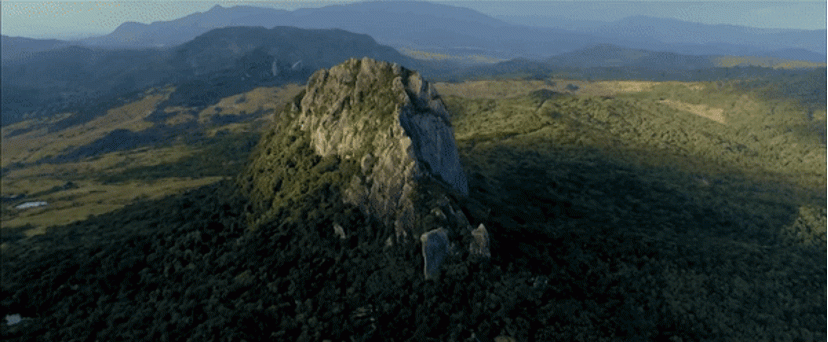
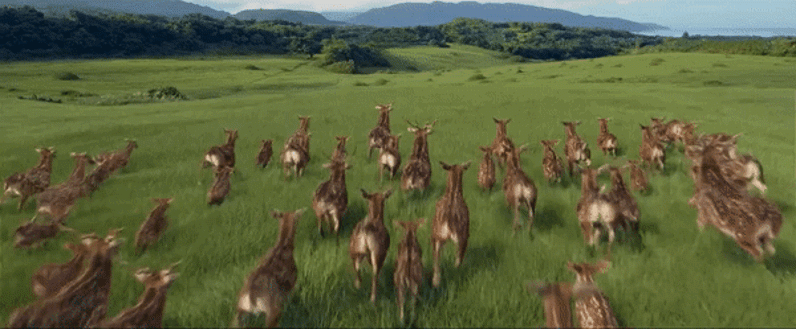
The first sequence of episode 1 of the series establishes the iconography that becomes strongly attached to both Butterfly’s and Taiwan’s identity. The opening shots show Butterfly walking along a mountain stream and seeing a vision of her dead mother, followed by an aerial drone shot of the rainforest that is her ancestral home. After the aerial shot, we see a swarm of CGI butterflies, which are associated in the series not only with Butterfly herself but with the spirit of her mother. Just over a minute later, there is another sequence of three shots that introduce more of the key motifs of the series. A mountain tribe gathers with a striking geological feature looming on the near horizon (Figure 2), which is followed by another aerial shot—one that will be repeated later in the series—circling the same peak. This cuts to an aerial tracking shot following a herd of over forty Formosan sika deer. Together, these shots in the opening minutes of the series create metonymic as well as metaphoric connections among these key motifs.
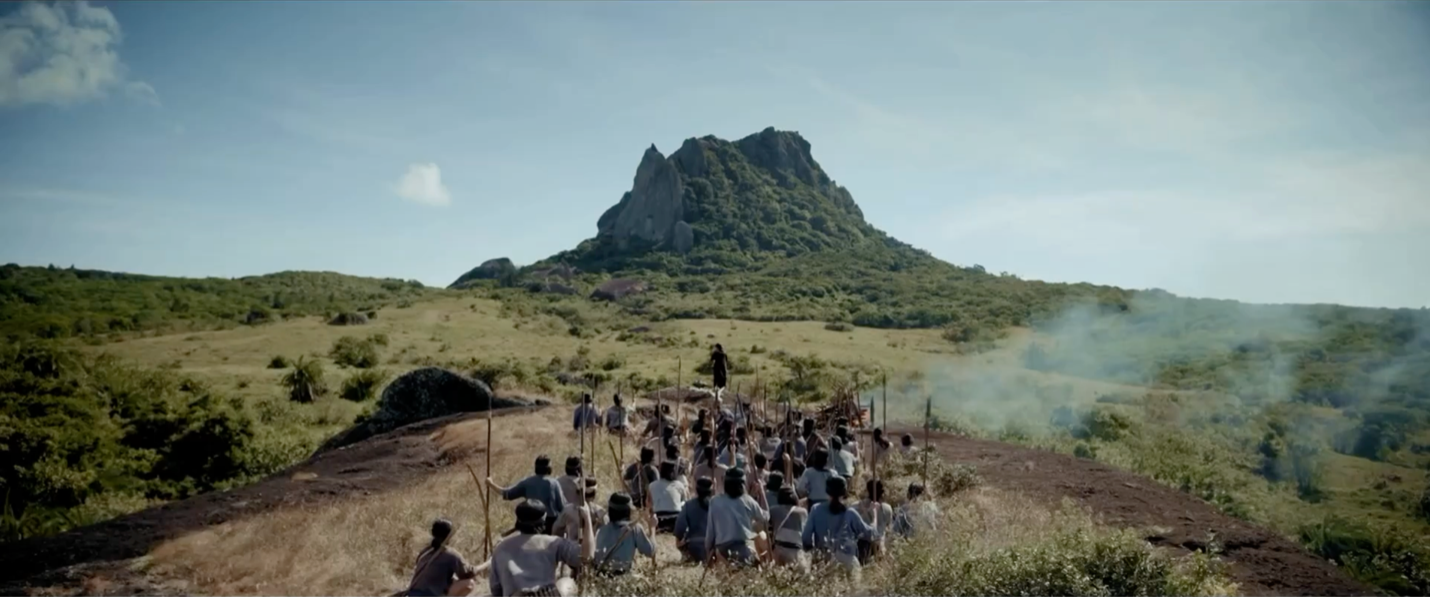
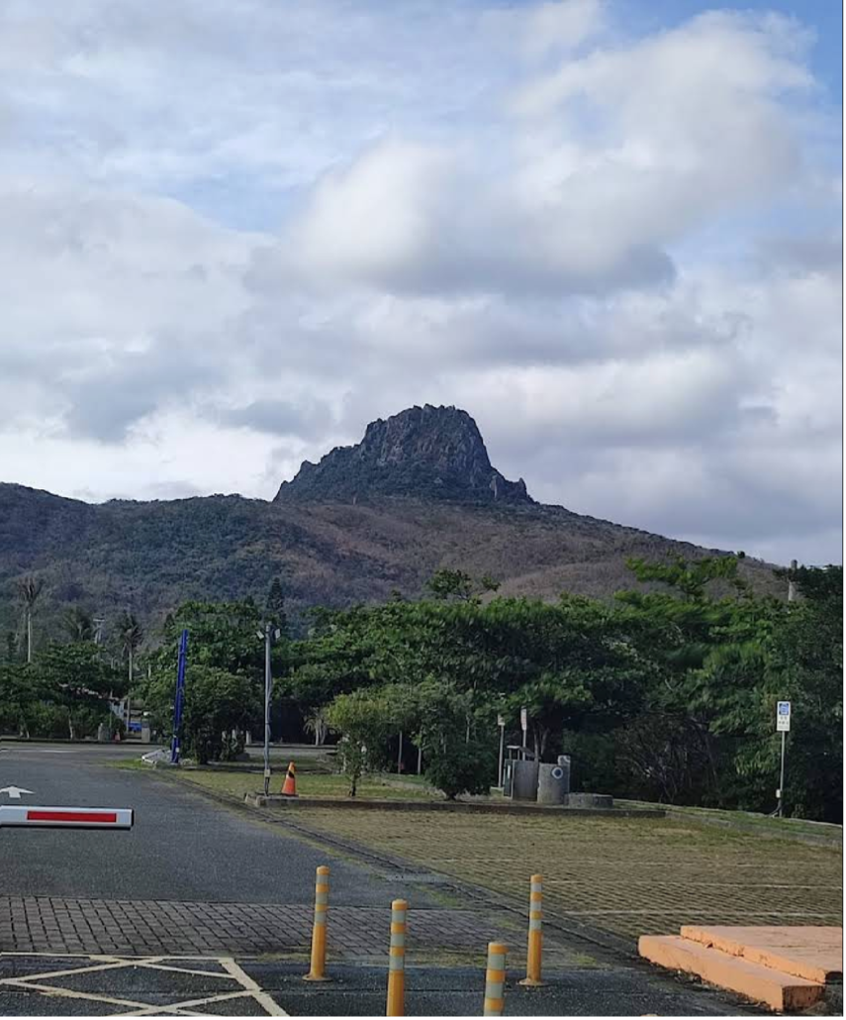
The geological feature in the two shots shown near the beginning of episode 1—the first with the tribe members gathered in the foreground and the second a circling aerial shot—is Mount Dajianshi (大尖石山), called Turtle Nose Mountain in the novel, today a sightseeing destination in what is now Kenting National Park (墾丁國家公園) on the southern tip of Taiwan. Figure 3 shows its appearance today as captured in a tourist photo. In Seqalu, CGI enhancement has removed all markers of contemporary human habitation to lend it a primordial, precolonial look. Multiple shots in the series connect this particular geological feature to the mountain aboriginal tribal grouping that gives the series its name and that takes Mount Dajianshi as a sacred place. The site thus comes to embody both Taiwan’s natural beauty and its indigenous heritage.
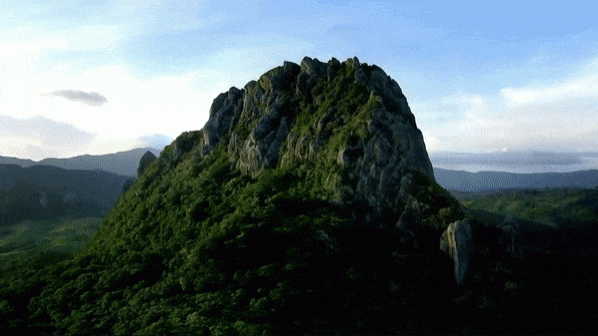
Aerial shots such as the repeated one of Mount Dajianshi cannot help but recall the award-winning 2013 film Beyond Beauty: Taiwan from Above, called simply Seeing Taiwan in Chinese (Kanjian Taiwan 看見台灣), an ecocritical documentary by director Chi Po-lin 齊柏林, produced by Hou Hsiao-hsien 侯孝賢 and narrated by frequent Hou collaborator Wu Nien-jen 吳念真, which broke the box office record for a domestically produced documentary in Taiwan and is credited with pressuring the government to face Taiwan’s environmental problems.1 On the documentary’s “problematic appropriation of Taiwan’s indigenous heritage,” see Bergthaller (2016), 60. That documentary’s footage was comprised entirely of aerial shots from a helicopter, and one shot of Mount Dajianshi near the beginning of the film seems to be almost replicated by the repeated iconic shot in the Seqalu series, albeit the latter from a higher altitude (Figures 4 & 5). Beyond Beauty: Taiwan from Above is separated into three parts, the first part devoted to such aerial shots of natural beauty, the longer middle section documenting environmental destruction on the island, and a shorter section at the end providing more upbeat hints at solutions to such problems while also invoking Taiwan’s indigenous heritage. As Kuei-fen Chiu notes in her study of Taiwanese ecodocumentaries, the film’s strength lies in its generation of affect, in particular audience identification with the land through an “ecosublime” aesthetic. Clearly, the aerial shots in Seqalu aspire to the same “impact aesthetic” of the ecosublime and are likely directly inspired by the popular documentary film (Chiu 2017, 25).
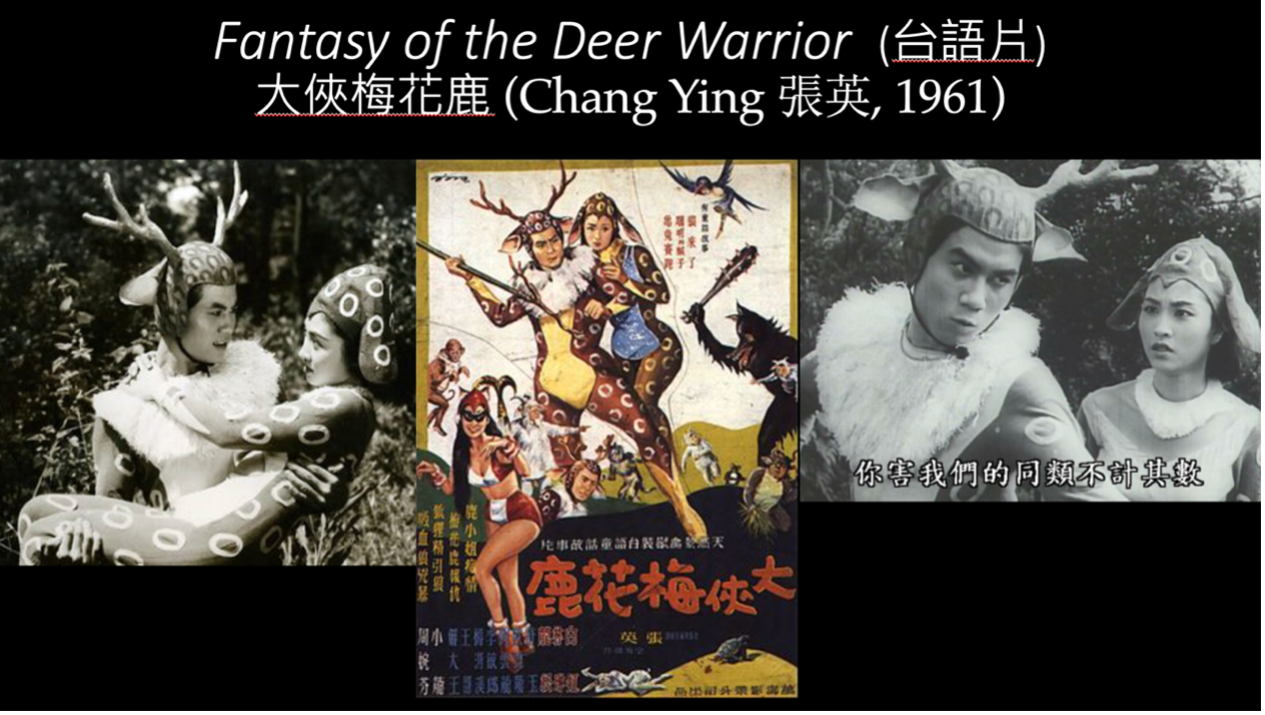
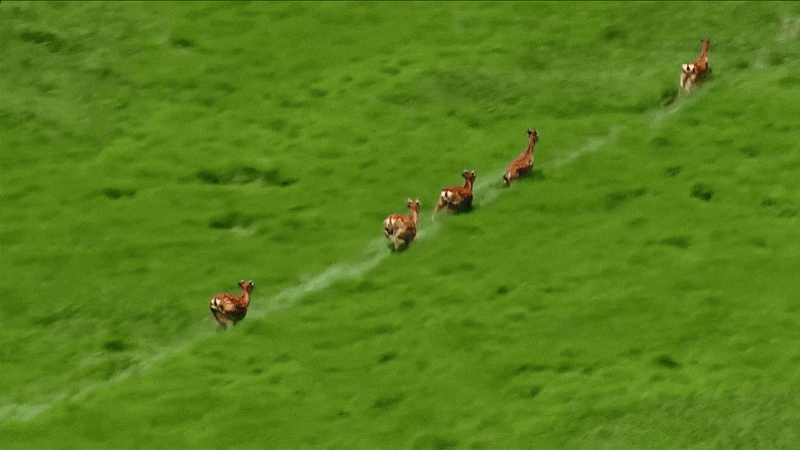
The Formosan sika deer, obviously rendered by CGI each time it makes its appearance in the series, also bears heavy symbolic weight. The subspecies is endemic to Taiwan and for thousands of years densely populated the western lowlands of the island from north to south. Beginning in the seventeenth century, millions of the animals were hunted and killed as Dutch and Chinese traders expanded markets for deer hides in mainland China and Japan. In addition, agriculture and urbanization eventually claimed most of the deer’s habitat, to the point that finally the last known wild sika deer on the island was killed in 1969. A small captive breeding population remained in zoos, however, and the deer have been gradually reintroduced to Kenting National Park, precisely where Mount Dajianshi is located and where many of the events of Seqalu occur. Today the wild population is estimated to exceed 1000, with hopes that such a successful reintroduction can be repeated elsewhere in Taiwan. The Formosan sika deer has long served to represent Taiwanese identity in the face of outside aggression, for example in the 1961 Taiwanese dialect film The Fantasy of the Deer Warrior (Daxia meihualu 大俠梅花鹿), often interpreted as an anticolonial allegory of the threat to Taiwan from Communist China, or perhaps clandestinely even from the then-current KMT occupiers, in which the attractive and kindhearted deer, played by humans in animal costumes, must fight off a pack of murderous invading wolves (Rosati 2022) (Figure 6). Sika deer also had appeared in the Beyond Beauty documentary; a side-by-side comparison shows another possible debt of Seqalu’s images to the earlier documentary (even as it also highlights the computer-animation of the fauna in the later show compared to the documentary’s real animals) (Figures 7 & 8).
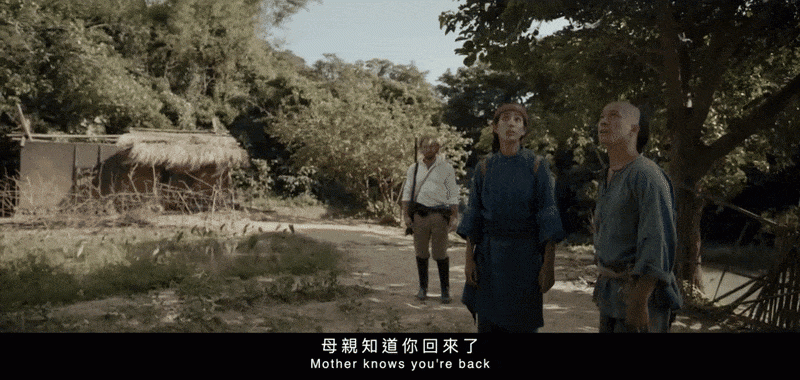
Finally, the CGI butterflies that are first seen in the opening shots of the first episode will return at key moments in the series. In episode 4, Butterfly and her brother visit their mother’s grave, and a swarm of fluttering butterflies suddenly appears all around them as Butterfly addresses her mother’s spirit. “Mother knows you’re back,” observes her brother, and even the French-American envoy who employs Butterfly as a guide and interpreter, Le Gendre, prays to the mother’s spirit later in the scene (Figure 9).
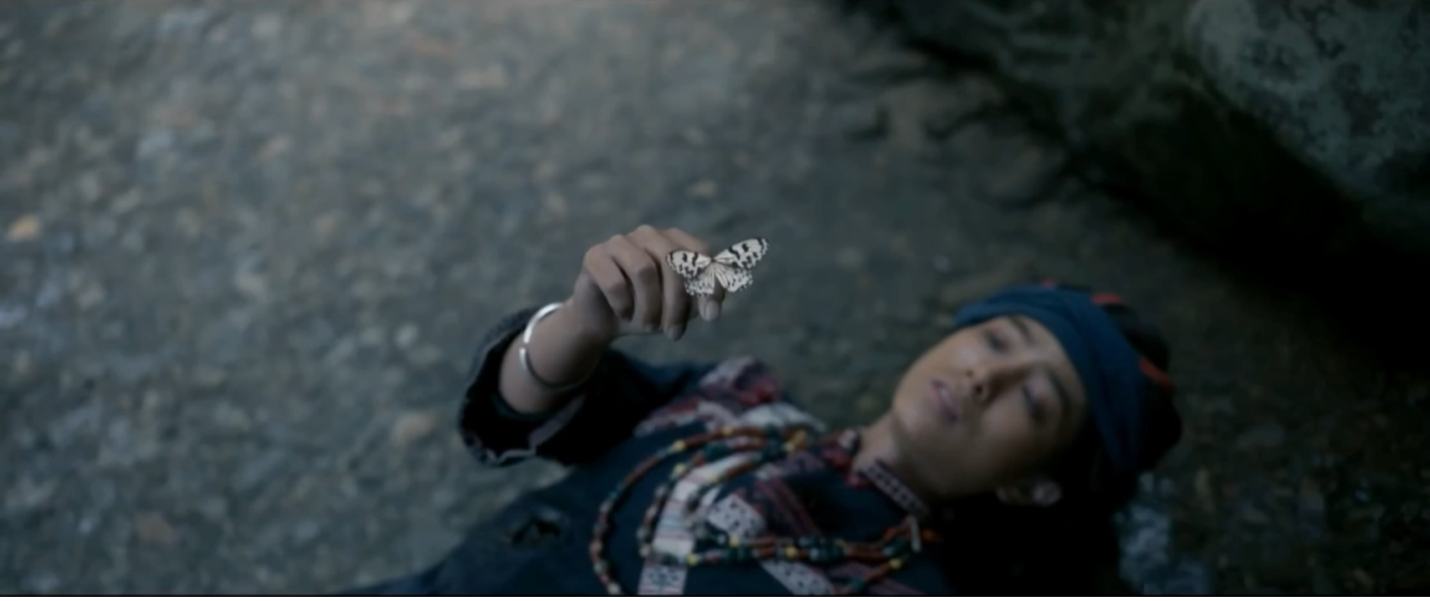
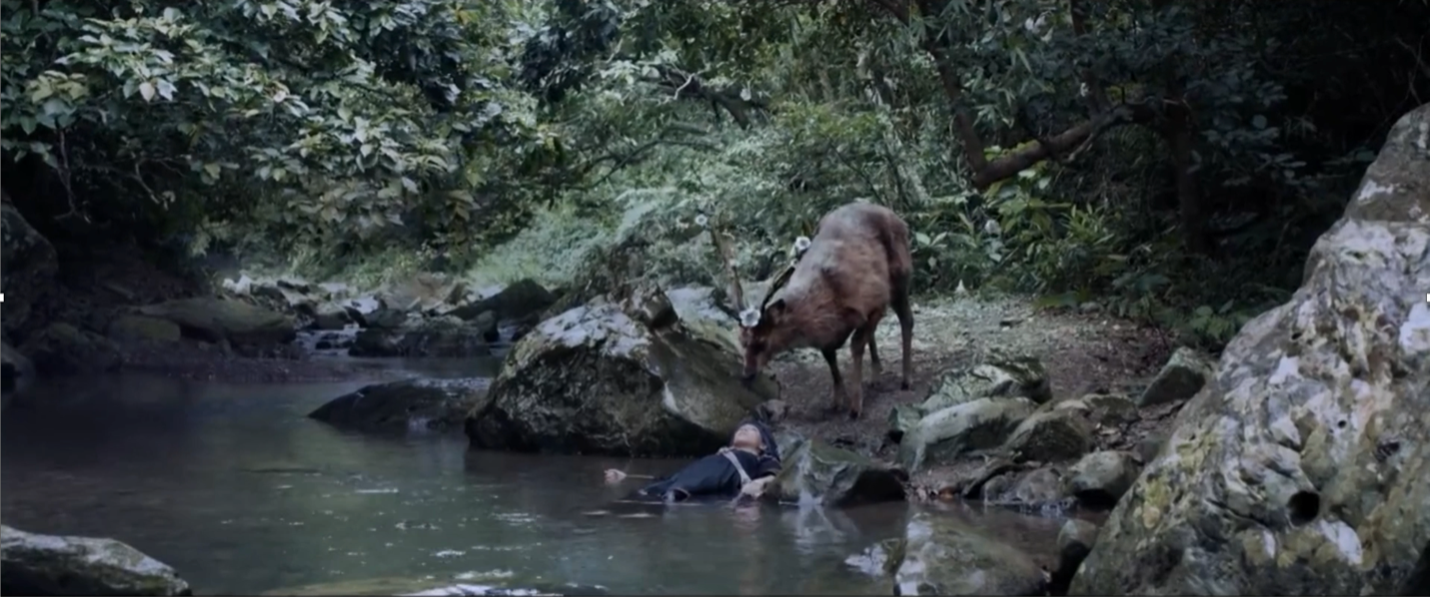
The CGI-generated Taiwanese fauna motifs return most forcefully, and connect to the crucial character Butterfly most closely, in the latter’s death scene in the show’s final episode. Having helped to successfully negotiate the peace treaty between the mountain aborigines and the Western powers seeking to protect future shipwrecked sailors, Butterfly has changed into the indigenous tribal clothing that both she and her mother had been wearing in the opening sequence of episode 1 discussed earlier. After visiting her mother’s gravestone and telling her, “Mother, I have returned to our land,” she walks in a shallow stream in the mountains, stops to take a drink of the water, and suddenly is ambushed and shot twice by Han Chinese (recognizable by the Qing-dynasty-enforced pigtails in their hair). Supine on her back and dying, Butterfly is again surrounded by a swarm of fluttering CGI butterflies, her outstretched hand briefly serving as a perch for one of them (Figure 10). “Mother,” she says, before closing her eyes and dying while a CGI deer buck comes to the stream bank to sniff her and see her off to join her ancestors (Figure 11). Since Butterfly had been the protagonist and point-of-view character for the audience from the beginning of the series, this scene, lifted to a transcendent level by its magical realist CGI, is an extremely affecting moment, surely intended as tearjerking for anyone who has watched the entire series.
As these examples have shown, CGI is a key tool through which Seqalu seeks to intensify its intended affective force. On one hand, it offers obvious convenience compared to attempting to direct, say, swarms of butterflies or an actual deer buck appearing at the death scene of a main character. More important, however, it allows for a more fantastical and transcendent vision of Taiwan’s flora and fauna, erasing markings of modernity to achieve a vision of a pristine, primordial land of Formosa with enchanted life forms. The deer buck that sees off Butterfly’s spirit, for example, is an especially large one festooned with large flowers in its antlers. CGI thus enables the magical realism of the series and intensifies its import as not just a historical drama but a kind of founding myth of Taiwanese-ness.
Butterfly as Martyr and Virgin Mother of Modern Taiwanese
Darryl Cameron Sterk, in a study of literary and film representations of “the vanishing Formosan,” has observed that “initially, the aboriginal maiden is a figure for colonial landscapes and resources, while later, in her conversion in fact or fiction from aboriginal to settler, she helps build national identity” (Sterk 2009, ii). In other words, there is a long history of narrative employments of aboriginal maiden figures as a means to help build settler nationalism. In the Seqalu narrative, aside from facilitating diplomacy through her multilingualism and the trust she has earned from both Le Gendre and Tokitok, Butterfly functions most importantly as an embodiment of Taiwanese identity, connecting through her own hybridity the indigenous inhabitants of the island with the Han settlers. She is, in the words of author Chen Yao-Chang himself in his preface to the English edition of the novel, “an avatar of Taiwan” whose role has what he calls “supreme significance” even though—or perhaps more accurately, because—she is the only one of the book’s main characters who is entirely fictional (Chen 2023, xxiv).
If anything, Butterfly’s role is even more crucial in the TV series based on Chen’s novel, for it is only in the TV series that she becomes a martyred sacrificial virgin and practically an object of worship in the concluding episode of the series. In the novel, Butterfly is creepily ogled by Le Gendre from their first meeting and eventually is in fact raped by him on the very night before he goes to the crucial peace treaty council with Tokitok. The novel does not have her even present at the treaty council with him, whereas in the television show she plays a crucial mediating role and certainly is not sexually assaulted the night before. In the novel, after the brutal rape by Le Gendre, she hates him passionately and eventually marries her plains aboriginal companion Chinya (Songzi 松仔). By the novel’s epilogue, she has birthed a child and become a successful folk doctor due to her earlier training by Dr. Manson. In the television series, the storyline of her medical training is mostly dropped, Le Gendre’s fondness for her is cast as more paternal than carnal, and she dies young, while still a virgin, rather than settling into a satisfying familial and professional life.
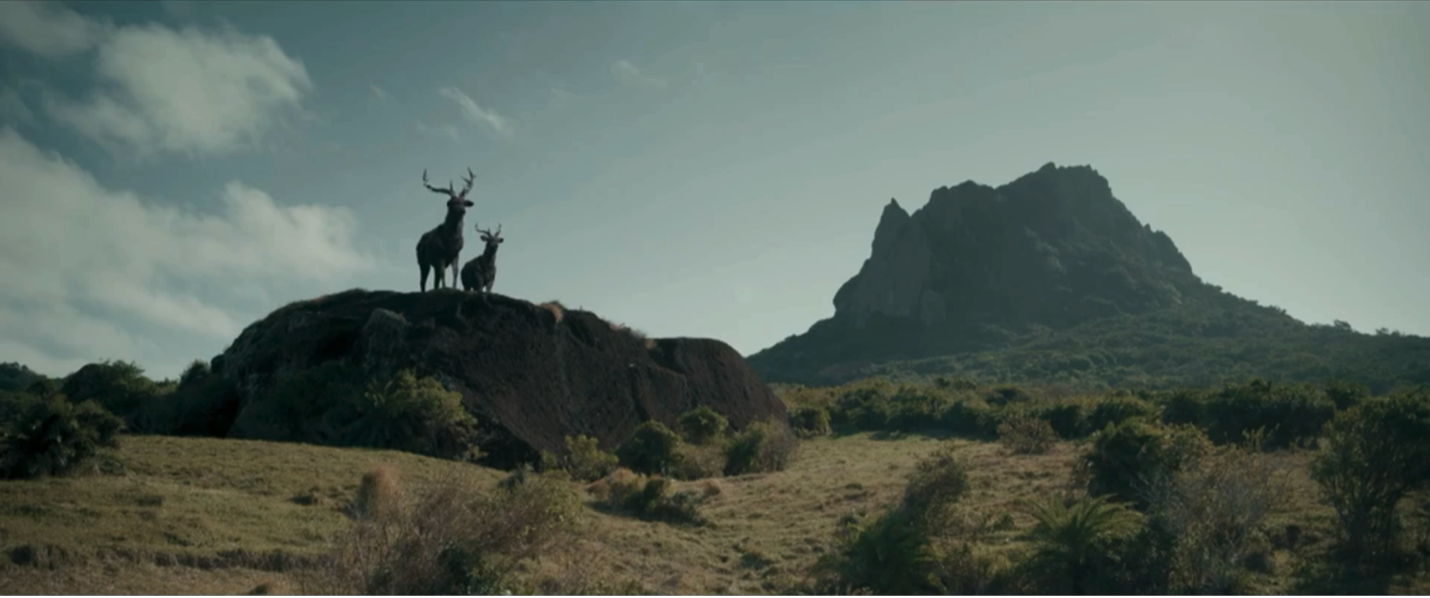
The series ends with a coda set two years later, when Le Gendre, Pickering, and Dr. Manson pay their respects to an ailing Chief Tokitok near the end of his life and then visit Butterfly’s tomb. The nearly eleven-hour series concludes with a reflection on Butterfly’s significance, accompanied by the now familiar CGI fauna and aerial cinematography. After their emotional visit to her grave, walking on Taiwan’s hilly plains with several Chinese porters, the key foreigners Pickering, Le Gendre, and Dr. Manson reminisce about the dear young friend they have lost, concluding that “she is at peace now in the beautiful mountains and beautiful lands that she calls home.” As the dialogue continues, the image cuts away from the men to an aerial drone shot sweeping across the pristine landscape, with multiple groups of CGI deer visible on the plains below. The aerial shot then cuts to another view of Mount Dajianshi, in front of which two CGI deer with flowers in their antlers pose, first in a closer shot and then at a longer distance (Figure 12). Following their pose, as if having bid the audience goodbye, the deer turn and walk away over a ridge, whereupon the series concludes with the exact same circling aerial shot of Mount Dajianshi that had appeared in the opening minutes of episode 1. After the final image, a concluding title indicates that the series is “dedicated solely to Taiwan” (僅將此片獻給台灣). Remarkably, throughout the sequence, and continuing from the a previous scene at Butterfly’s tomb, the soundtrack surges with the melody of the Christian hymn “What a Friend We Have in Jesus.” 1 I am grateful to Libby Kao for pointing this out to me.
There is much to unpack here. First, why end with a Christian hymn? To an overseas audience it may seem out of place in a series and an ending celebrating the indigenous heroine of the story. In fact, however, it is far from surprising given the fact that, while only approximately six percent of Taiwan’s population is Christian, about seventy percent of the indigenous people in Taiwan today are Christian due to centuries of missionary activity—including services such as health clinics, schools, and orphanages (Alsford 2021, 23). As Munsterhjelm summarizes, “Christianity has become an important factor politically, organizationally, and culturally for many Aborigines over the last century, and it is today an integral part of most Aboriginal communities” (Munsterhjelm 2014, 23).
The Christian theme also reinforces the image of Butterfly as a sacrificial martyr. When Pickering asks, referring to Butterfly’s murder, “Who could have done this?” Le Gendre answers: “It was us. We did it.” Butterfly thus metaphorically is martyred in the service of peace, not just peace among the indigenous people, the Americans, and the Qing army, but perhaps more importantly in the service of unity in Taiwan’s potentially volatile ethnic diversity, painstakingly depicted throughout the series and persisting to this day, as described in the discussion of Taiwan’s demographics above. As a half Han, half indigenous Formosan princess, Butterfly symbolically imbues all future Taiwanese with “fractional aboriginality” and represents the ideal of a Taiwanese people whose newly claimed shared indigenous ancestry—given the imprimatur of scientific truth by figures such as the genetic scientist-doctor who wrote Puppet Flower—marks them as a separate people from mainland Chinese, deserving their own state. At the same time, somewhat ironically, the virgin martyr figure cannot help but draw additional affective power from the longstanding Chinese tradition of celebrating chastity martyrs (lienü 烈女) and exemplary women (lienü 列女), so that the assertion of a distinctively Taiwanese identity contains echoes of Chinese Confucian ideology. Butterfly’s transformation from being raped by a foreigner in Puppet Flower to dying a virgin martyr in Sequalu is certainly significant. Sterk’s study of the figure of “the aboriginal maiden in postwar Taiwanese film and fiction” is replete with instances of indigenous women being raped and falling into abjection, prostitution, or worse; Butterfly, in contrast, in the television show is chaste unto martyrdom and becomes almost an object of worship by the foreigners, including the one who had raped her in the novel. Rather than a national allegory representing, say, the defilement of aboriginal lands by settlers, or the rapacious designs of potentially colonizing foreigners, she exemplifies a pure, originary Taiwanese identity that is hybrid in its essence.
Seqalu’s Ideological Work
Veracini notes that in settler-colonial narratives, in the process of establishing autonomy from the metropole, the indigenous Other can act as a fetish for the settler, whose identity is intrinsically ambivalent due to the simultaneous desires to both disavow and become the “native” (Veracini 2010, 87). In the novel Puppet Flower and especially the TV show Seqalu, the central character Butterfly appears as an externalization of the desire to connect with a Taiwanese-ness that is inclusive but still primordial, reconciling the authority of the settler with the authenticity of indigeneity, and thus empowering the settler to assert an identity separate from the homeland. As a genetically mixed medium between indigenous and Han identities, Butterfly offers the possibility for broad participation in a collective Formosan subjectivity. In the TV show she becomes not just a fetish but a martyr as well, a virgin sacrifice who dies for the sins of the settlers while giving them access to the authenticity of indigeneity. All Taiwanese are symbolically descendants of Butterfly, the martyred Formosan princess, providing what Melissa Brown has called a Taiwanese “narrative of unfolding,” a selective narration of the history of a people as “an inevitable unfolding of destiny” that thereby posits a distinct nation (Brown 2004, 6).
Seqalu was produced under the auspices of the pro-independence Pan-Green political coalition led by the Democratic Progressive Party, which has controlled the executive branch of the government from 2016 to the moment of this writing. Of course, it is no surprise that public television under a DPP government would offer works that help to build the image of a sovereign Taiwanese identity. From its first broadcast in 2021, the show was considered a sensation that attracted wide attention. Then-President Tsai Ing-wen (蔡英文, 2016–2024) hailed it on social media as a “unique and magnificent story born on the land of Taiwan.” Voicettank (思想坦克) columnist Chen Wen-lan 陳文瀾 called it “a phenomenon in Taiwan” that “broke the record for highest rating of a premiere in PTS’s [Taiwan’s Public Television Service’s] 21-year history, and has been the hottest topic in Taiwan ever since the end of the [2020] Olympics.” Chen noted that “even though the show sparked praise and criticism, it has made more people passionate for Taiwanese history and opened a new page for Taiwanese dramas.” Some viewers complained that the plot was too complex and the editing too confusing (e.g., Chu 2021), while others critiqued its historical veracity (e.g., Zhang 2021). Still, even the generally pro-KMT major newspapers such as the China Times and United Daily News published thoughtful discussions that were not entirely negative, though they critiqued several of the show’s oversimplifications of history (Liu Liangsheng 2021, Liu Xinyuan 2021, Xiu 2021, Yan 2021). Like some of those, but more vociferously critical, the Taipei publication The Observer accused the show of historical distortion and an agenda of de-Sinicization, critiqued its negative portrayal of the Qing General Liu Mingdeng, whom it called “truly a national hero,” and insisted that Puppet Flower author Chen Yao-Chang had a “complete ignorance” of the historical period he wrote about (Zhang 2021). The main pro-independence newspaper Liberty Times, meanwhile, published an approving review that concluded, “We hope that more works will allow us to engage with the history of Taiwan’s diverse ethnic groups, establish a narrative unique to Taiwan, and move towards a truly harmonious society where all ethnic groups coexist and thrive” (Lian 2021).
Seqalu received some praise by local indigenous communities for involving some of their members in the cast and the production process, and it received support from local politicians who appreciated the economic activity and publicity brought by its on-location shooting. However, indigenous voices also joined in the criticisms of the series. A critique published in a quarterly publication by the Council of Indigenous Peoples (原住民族委員會) accused the show of “obscuring the diversity and complexity of Taiwan’s population by simplifying its subjectivity to a singular ‘Taiwan’ and using the story of Indigenous peoples as a packaging for a nationalist [literally ‘national ethnicity’] mindset” (Drangadrang Kaljuvucing 2021). Like many critics, the same author charged the show with inaccuracies concerning tribal groupings and namings as well as painting a misleading picture of how leadership worked in indigenous communities, showing the functioning of “chiefs” as more hierarchical than in reality. Indigenous Pan-Blue politician Kao Chin Su-mei (高金素梅; also known as May Chin or by her indigenous name, Ciwas Ali 吉娃斯·阿麗) released a video on Facebook and YouTube in which she noted that in the same year that Charles Le Gendre signed his treaty with Tokitok, American Sioux Chief Red Cloud faced blatant US government treaty violations that deprived his people of much-needed grain, and she speculated as to what Red Cloud might have told Tokitok about dealings with American colonizers. Le Gendre, she pointed out, as a veteran of the Union side during the American Civil War, would have been very well aware of the routine American violations of treaties with its own Native peoples. Moreover, like several other commentators, she blasted the TV series for its depiction of Le Gendre as a kindly and honorable man, when in fact he would later offer his significant knowledge and services to the Japanese in their ambition to colonize Taiwan themselves.
Transfer and Settler Indigenization
Veracini theorizes that in a settler-colonial situation, the settlers define themselves against two kinds of Others in their midst, the indigenous Other and the exogenous Other—the former being the native peoples and the latter being outsiders residing in the colonized land who are not recognized as belonging there the way the settler does (for example, enslaved Africans in the early United States, or southeast Asian manual laborers in Taiwan today). The settler community seeks ideally, though perhaps never entirely successfully in practice, to have become triumphant enough in indigenization and autonomy from the metropole to have essentially “ceased being settler colonial” (Veracini 2010, 32). Toward this end, with regard to the indigenous Other, the settler community performs one or more of many possible strategies of transfer, meaning disappearance, either of the native or at least of their otherness, from the settler society. One method of transfer describes the fate of the former plains aboriginal tribes of Taiwan, whose languages and cultures had effectively already vanished by the end of the Qing occupation: assimilation—which, Veracini notes, could also be labeled as absorption by the settler community (Veracini 2010, 38). Seqalu implicitly supports two other kinds of transfer. One is a form of “narrative transfer” that claims “settlers are also indigenous peoples” with reference to a historical moment of “settler ethnogenesis” (Veracini 2010, 42). In the creation of Butterfly as a symbolic half-indigenous/half-Han “avatar of Taiwan,” Puppet Flower and Seqalu enact such a moment of “settler ethnogenesis.” Veracini notes that such a transfer through historical narration is often conjoined with a more contemporary claim of “settler indigenization” (Veracini 2010, 46). Butterfly’s mixed blood, combined with the iconic status bestowed on her, implicitly bolsters the view that typical Han Taiwanese today have some indigenous DNA and are therefore genetically distinct from Han Chinese in mainland China. With the claiming of indigeneity for all Taiwanese, as Veracini notes of these kinds of transfer, “the indigenous segment of the population system is discursively invaded by settler constituencies claiming their indigeneity, [and] indigenous specific alterity becomes effaced” (Veracini 2010, 46).
The claim of genetic difference from mainland Han Chinese, and thereby also some measure of indigeneity for all Taiwanese, is of course extremely problematic in several ways. Perhaps most importantly, transfer by settler indigenization—the claim that Han Taiwanese generally have indigenous Formosan ancestry—obviously invites the same sorts of critiques that, for example, indigenous Latin Americans have raised about the overstating of mestizo identity to claim indigeneity for all or most Latin Americans; as indigenous activists and scholars have pointed out, many of those eager to claim indigeneity today in fact do not come from communities that have suffered the hundreds of years of prejudice and discrimination that actual indígenas communities, in addition to African Latin American communities, have suffered (Mega 2021). Making a similar claim to indigeneity for all, or most, Taiwanese threatens to both erase the distinctiveness of the multiple surviving indigenous peoples and to paper over the land loss, prejudice, material deprivation, and cultural imperialism they have suffered over centuries—suffering manifested in the most concrete material ways, such as inferior health and a life expectancy that averages ten years lower than that of Han Taiwanese (Liu 2012, 339). Whether in the case of Latin America or Taiwan, as Shu-mei Shih argues, settler descendants, “by claiming their own mixedness, … tend to collapse the difference between mestizaje and indigeneity, even as their hegemony over those who are identified and identify themselves as indigenous peoples” continues to operate in a settler-colonial fashion (Shih 2021, xvi). Shih concludes:
Whether appropriating or usurping indigeneity by the mestizx in Latin America, or disavowing indigeneity by mixed-blood creole Han Taiwanese in Taiwan, the effect has been largely the same: as majority and hegemonic populations, they have exercised settler colonialism in their respective places. … With some clarity, we can state how not to decolonize Taiwan studies: neither by the creole political and economic elite claiming ethnic and cultural superiority and difference over indigenous peoples, nor by claiming indigeneity for themselves (Shih 2021, xvi).
The problematic nature of the Pan-Green appropriation of indigeneity is made evident by the tension that has existed between that political coalition and Taiwan’s indigenous communities themselves even as the former has long pursued a coalition with the latter, with varying degrees of success. The Taiwan Indigenous People’s Movement was launched in 1984 with the establishment of the Alliance of Taiwan Aborigines. Accelerated in the early 1990s, it advocated “the goals of ‘name rectification,’ return of land, and inclusion in the Constitution” (Simon and Awi Mona 2023, 190). The DPP’s Chen Shui-bian (陳水扁; Taipei mayor 1994–1998 and Taiwan’s first non-KMT president 2000–2008) actively courted the indigenous movement, establishing the groundbreaking Taipei Municipal Aboriginal Affairs Council as mayor and then signing a “New Partnership between Indigenous Peoples and the Taiwan Government,” which recognized the “natural sovereignty” (自然主權) of indigenous peoples as he campaigned for president in 1999 (Simon 2006, 256–257). In 2000, the DPP issued a White Paper on Indigenous Rights that condemned “Greater Chinese Chauvinism,” classified the KMT as just another occupying colonial regime, and recognized indigenous “inherent sovereignty” (宗主權) and rights to land, political participation, social welfare, educational and cultural opportunities, and gender equality (Simon 2006, 257–258). The goal was to forge an “alliance between indigenous peoples and so-called ‘New Taiwanese,’” referring to the descendants of Han settlers before 1949 (in contrast to the KMT’s Ma Ying-jeou’s wider use of the term to include the later mainlander settlers) (Simon 2007, 232). After gaining the Taiwan presidency in 2000–2008 and again in 2016, successive DPP administrations made real progress in fulfilling these promises, first through an Indigenous Traditional Territory Survey (原住民族傳統領域調查) launched in 2002 and then through the Indigenous Peoples Basic Law, passed in 2005 under President Chen Shui-bian and amended in 2018 under President Tsai Ing-wen, which protected the rights to land, language, education, healthcare, and self-government for sixteen officially recognized indigenous groups (an increase from nine that had been recognized previously by KMT regimes).
Despite such concrete measures to create an alliance between the project of Taiwanese nationalism and the indigenous social movement, tensions remained, and indigenous communities have consistently voted at much lower rates than Han voters and leaned Pan-Blue in their own political voting patterns (Pao and Davies 2021; Munsterhjelm 2014, 22). There are many reasons for this, including an embedded tradition of patronage for those communities going back to decades of KMT rule, a centuries-long history of conflicts between indigenous peoples and Han Taiwanese settlers, and an image of DPP supporters as violent (Pao and Davies 2021, 173–175). Also doubtlessly playing a role, however, is distrust among indigenous communities of the Pan-Green “instrumental support of indigenous peoples” and particularly the appropriation of indigeneity for all Taiwanese; after all, the same DPP White Paper of 2000 explicitly claimed métis status for “the vast majority of Taiwanese” (Simon 2007, 232). In fact, despite aboriginal activists being among the first to embrace the “Austronesian homeland concept” following Bellwood’s 1991 study (Munsterhjelm 2014, 32), and despite its employment by both DPP and KMT governments to decrease diplomatic isolation through participation in international indigenous rights efforts (Wang 2021, 230) and particularly to increase diplomatic ties with Southeast Asian states (Davies 2021, 262–269), interviews show that “the concept of Austronesian identity has little resonance within Taiwan’s indigenous communities themselves” (Davies 2021, 269). Again, to appreciate the distinction between the Han settler situations in Tibet and Xinjiang compared to Taiwan, one need only imagine the skepticism that ethnic Tibetans and Uyghurs would likely harbor if some future Han majority were to seek independence from China within Tibetan and Uyghur lands while claiming those identities for themselves.
In any case, beyond the problem of usurped indigeneity, any claim about genetic difference based on the idea of a Han ethnicity can only be based on a confusion of social constructs with actual biology, due to the very nature of the concept of a Han ethnicity. Thus, US-based Taiwanese critic Liu Liangsheng 劉良昇, writing about Seqalu for the China Times, one of Taiwan’s premier daily newspapers, pointed out that the so-called “Han people” are actually a “melting pot,” and “the Han ethnic group can only be considered a cultural concept … and should never be discussed in terms of bloodline or lineage” (Liu Liansheng 2021b). Races and ethnicities in general are not scientific facts or objects but discursively constructed imagined communities, and, as Frank Dikötter establishes from the very beginning of his classic study The Discourse of Race in Modern China, “the very idea of the ‘Han’ as a majority group was precisely the result of racial discourse” (Dikötter 2015, xv). Han identity emerged as a modern discourse tied to the importation of Western ideas of racial difference, the strong influence of Herbert Spencer’s social Darwinism in the late Qing and early Republican periods, the modern cult of the mythical Yellow Emperor and the imagining of all Han as his descendants (whereas “Han” had originally meant descendants of the Han Dynasty), and the rise of modern Chinese nationalism as part of the revolution against the Manchu Qing Dynasty and the resistance to Western and Japanese imperialism and colonialism (Dikötter 2015, 61–78). As Laura Hostetler put it in her study Qing Colonial Enterprise: Ethnography and Cartography in Early Modern China, “At a broad level of generalization, ‘han’ is a bit like the term ‘white.’ It brings together a diverse grouping of people under one common rubric, thus creating a shared condition that can exist only by virtue of its contrast to apparently greater difference—‘black,’ Hispanic, Manchu, Miao, etc.” (Hostetler 2001, 6, note 12). The biological essentialism of claims to genetic difference between Taiwanese Han and mainland Han effaces the vast diversity among those identified/constructed as “Han” in general, ahistorically homogenizing the quite diverse mainland people identified as such into an external Other of Taiwan. In addition, in the process, it can’t help but imply that Taiwan’s waishengren—those whose ancestors or who themselves migrated from mainland China with the Nationalist retreat in the mid-twentieth century rather than centuries earlier—are what Veracini calls the exogenous Other: residents who don’t really belong, at least until they are fully assimilated/absorbed themselves.
Is the Settler-Colonial Frame Necessary?
I will conclude with an acknowledgement of the controversy concerning the very term settler-colonial. Only recently have some scholars—including Veracini himself as well as Shu-mei Shih, Kuan Da-wei (Daya Dakasi), Lin-chin Tsai, and others, as discussed earlier—begun to analyze Taiwan as fundamentally a settler-colonial society. My analysis of Puppet Flower and Seqalu follows Shih’s call for “the imperative of settler colonial critique” (Shih 2021, ix),1 Shih was perhaps the earliest cultural studies theorist to apply the “settler-colonial” label to Taiwan in Anglophone scholarship (Shih 2011, 713–714). and the discussion above already has addressed some of the possible objections to calling Taiwan a settler-colonial society.
Another, more general argument against the concept of settler colonialism grows from the notion that it immediately implies an ethical judgment against the descendants of settlers and a possible ethical imperative of decolonization consisting of the actual removal or even eradication of the so-called “settlers.” As a recent article in Dissent by Aziz Rana put it, critics fear the term implies that “the scales of justice can only be made right by removing those excoriated as ‘settlers.’” Recently, of course, this fear has been most noticeable in the discussions of Israel and Palestine. However, as Rana goes on to argue, the concept of settler colonialism should be measured as an analytical tool rather than an accusation of guilt against descendants of settlers. In that case, the ethical imperative of decolonization need not involve the removal of those called “settlers”—which, whether in Taiwan or in America, is in any case a “farcical nonstarter” (Rana 2025). What it does connote, however—ethically and politically—is a recognition of history and a commitment to acknowledging and seeking to redress the wrongs of the past, as well as a measure of restraint in claiming the authenticity of indigeneity for a majority population that in actual fact has benefitted materially and otherwise from the advantages of settler colonization while indigenous peoples have struggled mightily just to survive—or, in the case of several plains aboriginal peoples in Taiwan, have failed to survive.1 I should note that after centuries of assimilation, sometimes by force, under multiple colonial governments (Qing, Japanese, and ROC), particularly from the late nineteenth to twentieth centuries—involving not just intermarriage but, for example, the abandoning of indigenous names for Chinese names (see Brown (2004) in particular for details)—in the twenty-first century there have been efforts to restore plains aboriginal identity and culture, though in several cases the languages themselves have already gone extinct. See Jolan Hsieh (2018), “The changing identities of Taiwan’s Plains Indigenous Peoples” and (2021) “Restoring Pingpu Indigenous status and rights.”
To conclude, Seqalu simultaneously highlights and denies Taiwan’s status as a settler-colonial society. On one hand, it takes great care to represent the indigenous populations with the humanity and complexity that their history demands; on the other, in essentially distributing the authenticity of the indigenous people to the Taiwanese as a whole for the purposes of contemporary Taiwanese nationalism, it essentially nativizes the entire population in a way that disregards the very real predations (including loss of land, resources, cultures, and entire languages) of settler colonialism. Identification with the land they call home—and indeed with the other human and non-human living beings who share it—is perhaps bound to arise among the people of Taiwan in general, and an imaginary narrative, or even founding myth, of an intrinsically multiethnic shared Taiwanese identity is surely intended to be both inclusive and respectful of indigenous peoples. Considering the very real constant threat the PRC presents to Taiwan’s sovereignty, the deployment of “strategic biological essentialism” (Warin et al. 2020) in the service of Taiwanese nationalism is understandable. However, as Lin-chin Tsai emphasizes, true decolonization must surely go beyond symbolic gestures such as acknowledgments and apologies—or, in the present context, narratives of ethnic unity or shared indigeneity—to include an actual “politics of redistribution” in the “material realm” (Wu and Chen 2022). The Seqalu phenomenon marks a significant stage in the emergence of a sovereign Taiwanese identity while also calling for caution about some of its implicit claims. With the emergence of a sovereign Taiwanese nationalism comes a reckoning with the concomitant import of a now explicitly settler-colonial heritage.
Works Cited
Alsford, Niki J. P. “Population movements and the construction of modern tradition within contemporary Taiwan Indigenous society.” Taiwan’s Contemporary Indigenous Peoples, edited by Chia-yuan Huang, Daniel Davies, and Dafydd Fell, Routledge, 2021, pp. 18–33.
“The Backlands” 蠻荒之境. 斯卡羅 Seqalu: Formosa 1867, episode 4. 公共電視台 Taiwan Public Television Service, 21 August 2021.
Bellwood, Peter. “The Austronesian Dispersal and the Origin of Languages.” Scientific American, vol. 265, no. 1, 1991, pp. 88–93.
Bergthaller, Hannes. “Agrarian Origin Stories, National Imaginaries, and the Ironies of Modern Environmentalism: On Chi Po-lin’s Kanjian Taiwan (Beyond Beauty: Taiwan from Above).” Ecocriticism in Taiwan: Identity, Environment, and the Arts, edited by Chia-ju Chang and Scott Slovic, Lexington Books, 2016, pp. 55–64.
Beyond Beauty: Taiwan from Above 看見台灣. 齊柏林 Po-lin Chi (dir.), 侯孝賢 Hou Hsiao-hsien (prod.). Taiwan Aerial Imaging, Inc., 2013.
Blundell, David. “Taiwan Austronesian Language Heritage Connecting Pacific Island Peoples: Diplomacy and Values.” International Journal of Asia-Pacific Studies, vol. 7, no. 1, 2011, pp. 75–91.
Brown, Melissa J. Is Taiwan Chinese? The Impact of Culture, Power, and Migration on Changing Identities. University of California Press, 2004.
Chen, Wen-lan 陳文瀾. “台灣歷史劇開啟新頁──談《斯卡羅》 Seqalu: A New Page for Taiwan Historical Dramas.” Translated by Chieh-Ting Yeh. 思想坦克 Voice Tank, 17 August 2021, https://ketagalanmedia.com/2021/08/30/seqalu-a-new-page-for-taiwan-historical-dramas/.
Chen, Yao-Chang 陳耀昌. 傀儡花 Puppet Flower. 印刻文學 INK, 2016.
---. Puppet Flower: A Novel of 1867 Formosa. Translated by Pao-Fang Hsu, Ian Maxwell, and Tung-Jung Chen, Columbia University Press, 2023.
Cheng, Yinghong. “Taiwanese DNA versus Chinese DNA: Genetic science and identity politics across the Taiwan Straits.” Modern Asian Studies, vol. 57, no. 3, 2023, pp. 940–965.
Chiu, Kuei-fen. “Mapping Taiwanese ecodocumentary landscape: Politics of aesthetics and environmental ethics in Taiwanese ecodocumentaries.” Journal of Chinese Cinemas, vol. 11, no. 1, 2017, pp. 13–29.
Chiung, Wi-vun Taiffalo. “Languages under colonization: The Taiwanese language movement.” Changing Taiwanese Identities, edited by J. Bruce Jacobs and Peter Kang, Routledge, 2018, pp. 39–63.
Chu, Yu-Hsun 朱宥勳. “《斯卡羅》第一集觀後 After Viewing the First Episode of Seqalu.” Author’s personal website, 17 August 2021, https://chuckchu.com.tw/article/194.
Davies, Daniel. “The Austronesian narrative: The role of Indigenous heritage in Taiwanese diplomacy.” Taiwan’s Contemporary Indigenous Peoples, edited by Chia-yuan Huang, Daniel Davies, and Dafydd Fell, Routledge, 2021, pp. 256–274.
“Demographics of Taiwan.” Wikipedia, The Free Encyclopedia, retrieved 8 May 2026, https://en.wikipedia.org/wiki/Demographics_of_Taiwan.
Dikötter, Frank. The Discourse of Race in Modern China, 2nd ed. Oxford University Press, 2015.
“Ethnic Groups” 族群. 國情簡介 Brief Introduction to Country Characteristics, 行政院 Executive Yuan, https://www.ey.gov.tw/state/99B2E89521FC31E1/2820610c-e97f-4d33-aa1e-e7b15222e45a.
Friedman, P. Kerim. “The Hegemony of the Local: Taiwanese Multiculturalism and Indigenous Identity Politics.” Boundary 2, vol. 45, no. 3, 2018, pp. 79–105.
Hirano, Katsuya, Lorenzo Veracini, and Toulouse-Antonin Roy. “Vanishing Natives and Taiwan’s Settler-Colonial Unconscious.” Indigenous Knowledge in Taiwan and Beyond, edited by Shu-mei Shih and Lin-chin Tsai, Springer, 2021, pp. 225–248.
Hostetler, Laura. Qing Colonial Enterprise: Ethnography and Cartography in Early Modern China. University of Chicago Press, 2001.
Hsieh, Jolan 謝若蘭 (Bavaragh Dagalomai). “The changing identities of Taiwan’s Plains Indigenous Peoples.”Changing Taiwanese Identities, edited by J. Bruce Jacobs and Peter Kang, Routledge, 2018, pp. 12–26.
---. “Restoring Pingpu Indigenous status and rights.” Taiwan’s Contemporary Indigenous Peoples, edited by Chia-yuan Huang, Daniel Davies, and Dafydd Fell, Routledge, 2021, pp. 239–255.
Huang, Chi-an 黃其安. “Taiwan’s Original TV Series Strike a Chord With Both Domestic and International Audience.” Industry Research Database 產業研究資料庫, Taiwan Creative Content Agency (TAICCA) 文化內容策進院, 16 August 2021, https://research.taicca.tw/article/db7b69ef-f10e-3262-be66-af8d60ebc478.
“In Order to Be Free (May 1754 – May 1775).” The American Revolution, season 1, episode 1. Ken Burns, Sarah Botstein, and David Schmidt (dirs.). Florentine Films, 2025, https://www.pbs.org/kenburns/the-american-revolution.
Johnston, Anna and Alan Lawson. “Settler Colonies.” A Companion to Postcolonial Studies, edited by Henry Schwarz and Sangeeta Ray, Blackwell, 2000, pp. 360–376.
Kaljuvucing, Drangadrang 潘顯羊. “《斯卡羅》播出後的爭議與反思 Controversy and Reflections Following the Airing of Seqalu.” 原住民族委員會,原住民族文獻,文獻電子期刊:時事快遞 Council of Indigenous Peoples, Indigenous Peoples Archive, Journal of Electronic Archives: Current Affairs Express, no. 49, November 2021, https://ihc.cip.gov.tw/EJournal/EJournalCat/609.
Kao, Chin Su-mei 高金素梅 Ciwas Ali 吉娃斯·阿麗. “高金素梅轟《斯卡羅》不顧史實?! 別 把台灣原住民族當打造官方史觀道具?! Kao Chin Su-mei slams Seqalu for disregarding historical facts?! Don’t use Taiwan’s indigenous peoples as props for creating an official historical narrative?!.” YouTube, 新聞大白話TVBS Talk, 18 August 2021, https://youtu.be/F1cSZylLkLM?si=BYGEwMYqqOhUD-s4.
Kuan, Da-wei (Daya Dakasi). “Indigenous traditional territory and decolonisation of the settler state: The Taiwan experience.” Taiwan’s Contemporary Indigenous Peoples, edited by Chia-yuan Huang, Daniel Davies, and Dafydd Fell, Routledge, 2021, pp. 184–205.
Lian, Ke 連克. “《自由廣場》(北社評論)從斯卡羅─談臺灣觀點的羅妹號事件與多元文化社會 Liberty Square (Beishe Review) From Seqalu—On the Rover Incident and multicultural society from a Taiwanese perspective.” 自由時報 Liberty Times, 31 August 2021, https://talk.ltn.com.tw/article/paper/1469946.
Lin, Marie 林媽利. 我們流著不同的血液:以血型、基因的科學證據揭開台灣各族群身世之謎 We Have Different Blood: Using Scientific Evidence of Blood Types and Genetics to Unveil the Mystery of the Origins of Ethnic Groups in Taiwan. 前衛出版社 Avanguard Publishing, 2010.
Liu, Jennifer A. “Aboriginal Fractions: Enumerating Identity in Taiwan.” Medical Anthropology, vol. 31, no. 4, 2012, pp. 329–346.
Liu, Liangsheng 劉良昇. “《史話》 別把小說當正史──斯卡羅史觀爭議(一) Historical stories: Don’t treat fiction as official history—The controversy over Seqalu’s historical view (Part 1).” 中國時報 China Times, 13 September 2021a, https://www.chinatimes.com/opinion/20210913000002-262107?chdtv.
---. “《史話》 賣台奸商李仙得──斯卡羅史觀爭議(二) Historical stories: Le Gendre, the selling-out merchant of Taiwan—The controversy over Seqalu’s historical view (Part 2).” 中國時報 China Times, 14 September 2021b, https://www.chinatimes.com/opinion/20210914000001-262107?chdtv.
---. “《史話》 去中國化的操作──斯卡羅史觀爭議(三) Historical stories: The de-Sinicization of history—The controversy over Seqalu’s historical view (Part 3).” 中國時報 China Times, 15 September 2021c, https://www.chinatimes.com/opinion/20210915000002-262107?chdtv.
Liu, Xinyuan 劉新圓. “【專家之眼】《斯卡羅》是一部台灣錯過的歷史? Expert eye: Is Seqalu a piece of history that Taiwan missed?” 聯合報 United Daily News, 20 September 2021, https://udn.com/news/story/121823/5758502.
Mega, Emiliano Rodríguez. “The Rise of the Mixed-Race Myth in Latin America.” Nature, vol. 600, no. 7889, 2021, pp. 374–378.
Munsterhjelm, Mark. Living Dead in the Pacific: Contested Sovereignty and Racism in Genetic Research on Taiwan Aborigines. University of British Columbia Press, 2014.
Pan, Jason. “Taiwanese, Han Chinese ethnically distinct: expert.” Taipei Times, October 30, 2017, https://www.taipeitimes.com/News/taiwan/archives/2017/10/30/2003681322.
Pao, Cheng-hao and Daniel Davies. “Indigenous political participation and indigenous voting behaviour in Taiwan.” Taiwan’s Contemporary Indigenous Peoples, edited by Chia-yuan Huang, Daniel Davies, and Dafydd Fell, Routledge, 2021, pp. 165–183.
Pickering, William Alexander. Pioneering in Formosa: Recollections of Adventures among Mandarins, Wreckers & Head-hunting Savages. Hurst and Blackett, Ltd., 1898. [Adamant Media Corporation, 2005.]
Rana, Aziz. “Who’s Afraid of ‘Settler Colonialism’?” Dissent, Fall 2025, https://www.dissentmagazine.org/article/whos-afraid-of-settler-colonialism/.
Rosati, Adriana. “The Fantasy of the Deer Warrior kicks off ‘Taiyupian : The Insolent Taiwanese Cinema of The 1960s’ on HENRI.” Asian Movie Pulse, 2 March 2022, https://asianmoviepulse.com/2022/03/the-fantasy-of-the-deer-warrior-kicks-off-taiyupian-the-insolent-taiwanese-cinema-of-the-1960s-on-henri/.
Rudolph, Michael. “The Emergence of the Concept of ‘Ethnic Group’ in Taiwan and the Role of Taiwan’s Austronesians in the Construction of Taiwanese Identity.” Historiography East and West, vol. 2, no. 1, 2004, pp. 86–115.
“The Sea Wind” 海上的風. 斯卡羅 Seqalu: Formosa 1867, episode 1. 公共電視台 Taiwan Public Television Service, 14 August 2021.
Seqalu: Formosa 1867 斯卡羅. 曹瑞原 Jui Yuan Tsao (dir.). 公共電視台 Taiwan Public Television Service, twelve-part series, aired 14 August 2021–18 September 2021.
Shih, Shu-mei. “The Concept of the Sinophone.” PMLA/Publications of the Modern Language Association, vol. 126, no. 3, 2011, pp. 709–718.
---. “Introduction: Decolonizing Taiwan Studies.” Indigenous Knowledge in Taiwan and Beyond, edited by Shu-mei Shih and Lin-chin Tsai, Springer, 2021, pp. ix–xvii.
Simon, Scott. “Taiwan’s Indigenized Constitution: What Place for Aboriginal Formosa?” Taiwan International Studies Quarterly 台灣國際研究季刊, vol. 2, no. 1, 2006, pp. 251–270.
---. “Paths to Autonomy: Aboriginality and the Nation in Taiwan.” The Margins of Becoming: Identity and Culture in Taiwan, edited by Carsten Storm and Mark Harrison, Harrassowitz Verlag, 2007, pp. 221–240.
Simon, Scott E., and Awi Mona. “Between Legal Indigeneity and Indigenous Sovereignty in Taiwan: Insights from Critical Race Theory.” Social Inclusion, vol. 11, no. 2, 2023, pp. 187–197.
Stainton, Michael. “The Politics of Taiwan Aboriginal Origins.” Taiwan: A New History, edited by Murray A. Rubinstein, M. E. Sharpe, 1999, pp. 27–44.
Sterk, Darryl Cameron. The Return of the Vanishing Formosan: Disturbing the Discourse of National Domestication as the Literary Fate of the Aboriginal Maiden in Postwar Taiwanese Film and Fiction. Ph.D. dissertation, University of Toronto, Department of East Asian Studies, 2009.
Teng, Emma Jinhua. Taiwan’s Imagined Geography: Chinese Colonial Travel Writing and Pictures, 1683–1895. Harvard University Press, 2006.
“The Treaty” 盟約. 斯卡羅 Seqalu: Formosa 1867, episode 12. 公共電視台 Taiwan Public Television Service, 18 September 2021.
Tsai, Ing-wen 蔡英文. Facebook, 15 August 2021, https://www.facebook.com/tsaiingwen/posts/10157644579326065.
Tsai, Lin-chin. Re-conceptualizing Taiwan: Settler Colonial Criticism and Cultural Production. Ph.D. dissertation, University of California, Los Angeles, Asian Languages and Cultures, 2019.
Veracini, Lorenzo. Settler Colonialism: A Theoretical Overview. Palgrave Macmillan, 2010.
Wang, Ting-jieh. “Indigenous peoples and the politics of the environment in Taiwan.” Taiwan’s Contemporary Indigenous Peoples, edited by Chia-yuan Huang, Daniel Davies, and Dafydd Fell, Routledge, 2021, pp. 223–238.
Warin, Megan, Emma Kowal, and Maurizio Meloni. “Indigenous Knowledge in a Postgenomic Landscape: The Politics of Epigenetic Hope and Reparation in Australia.” Science, Technology, & Human Values, vol. 45, no. 1, 2020, pp. 87–111.
Wu, Chi-Yu 吳其育 and Chen Hsi-An 陳璽安. “思考白浪徵狀:與蔡林縉對話 Interview with Lin-Chin Tsai on the Symptoms of Settler Colonialism / Reflecting on the symptoms of white waves: A dialogue with Tsai Lin-Chin.” 數位荒原 No Man’s Land, no. 54, 31 December 2022, https://www.heath.tw/nml-article/interview-with-lin-chin-tsai-on-the-symptoms-of-settler-colonialism/.
Xiu, Ruiying 修瑞瑩. “有雷/《斯卡羅》結局再引熱議 陳耀昌:公視空前成就 Spoiler alert: The ending of Seqalu again sparks heated debate; Chen Yao-Chang: Public Television achieves unprecedented success.” 聯合報 United Daily News, 19 September 2021, https://style.udn.com/style/story/121034/5757173.
Yan, Rui-Ting 顏瑞霆. “《斯卡羅》的真實與虛構?被埋沒的台灣,與當代多方詮釋 The truth and fiction of Seqalu? A buried Taiwan and its various contemporary interpretations.” 聯合報 United Daily News, 6 September 2021, https://opinion.udn.com/opinion/story/122177/5724816.
Ye, Ruiping. The Colonisation and Settlement of Taiwan, 1684–1945: Land Tenure, Law and Qing and Japanese Policies. Routledge, 2019.
Zhang, Jianfeng 張健豐. “解析《斯卡羅》中的錯誤史觀 Analyzing the historical misconceptions in Seqalu.” 觀察 The Observer, October 2021, https://www.observer-taipei.com/book2021/item/90.
© The Author(s). This work is licensed under a Creative Commons Attribution 4.0 International License.